Canis lupus familiaris
Belgian Malinois
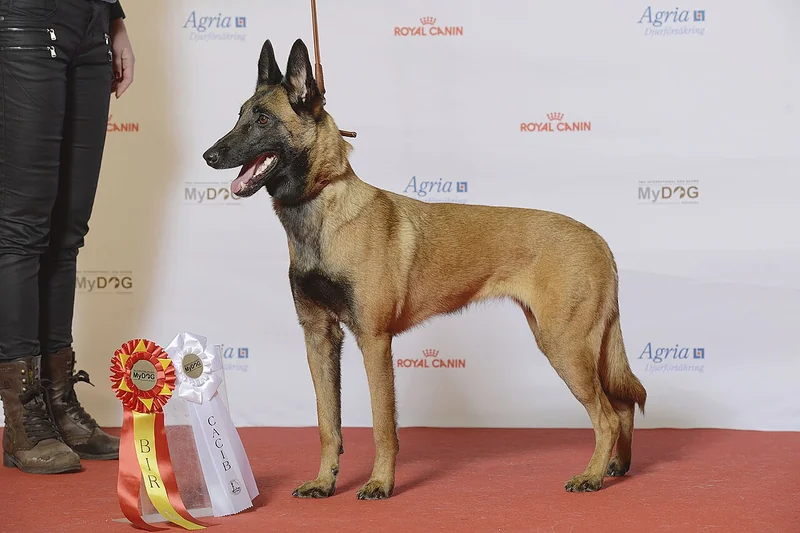 Featured photobelgian-malinois.jpg
The Belgian Malinois is a short-coated fawn-and-black-mask variety of the Belgian Shepherd — the modern military/police K9. The Belgian Malinois is one of four varieties of the Belgian Shepherd Dog (Belgische Herder), all descended from the same late-19th-century landrace of Belgian working sheepdogs and distinguished principally by coat type and colour.
Quick facts
- AKC group
- Herding
- Origin country
- Belgium (Mechelen)
- Origin period
- Late 19th century
- Coat type
- Short
- Coat colors
- Fawn, Mahogany, Red — all with the breed's required black mask and ear tips, often with black tipping on the body coat
- Average lifespan
- 14-16 years
- Recognition
- AKC 1959 · FCI 1956 · UKC 1959 · Group 1 — Sheepdogs and Cattledogs (Section 1: Sheepdogs — variety 4 of FCI No. 15: Belgian Shepherd)
Origin
The Belgian Malinois is one of four varieties of the Belgian Shepherd Dog (Belgische Herder), all descended from the same late-19th-century landrace of Belgian working sheepdogs and distinguished principally by coat type and colour. Belgian veterinarian Adolphe Reul standardized the four varieties in 1891. In Belgium and most FCI countries, all four varieties (Malinois, Tervuren, Groenendael / Belgian Sheepdog, Laekenois) are registered as a single breed (FCI No. 15: Belgian Shepherd Dog) and inter-variety crossing is permitted; the AKC, by contrast, registers them as separate breeds (Belgian Malinois, Belgian Tervuren, Belgian Sheepdog, Belgian Laekenois). The Malinois — the short-coated, fawn-with-black-mask variety, named for the city of Mechelen (Malines in French) where the type was concentrated — became the most common service-dog variety after the Second World War and is now the dominant military and police K9 worldwide.
Recognition
The American Kennel Club admitted the breed in 1959, the United Kennel Club followed in 1959, and the Federation Cynologique Internationale published the international standard (FCI No. 15) in 1956. The FCI assigns the breed to Group 1 — Sheepdogs and Cattledogs (Section 1: Sheepdogs — variety 4 of FCI No. 15: Belgian Shepherd).
Standard
The AKC and FCI standards describe a well-balanced, square dog, elegant in appearance with an exceedingly proud carriage of the head and neck, conveying the impression of impressive strength without bulkiness. The defining features are the short, straight, hard outer coat with a thick undercoat, and the rich fawn-to-mahogany base colour with the required black mask, black ear tips, and black tipping along the outer guard hairs. Males stand 61-66 cm at the withers, females 56-61 cm.
Sources & further reading (3)
- kennel-club-registry — accessed 2026-04-30
- encyclopedia — accessed 2026-04-30
- fci-standard — accessed 2026-04-30
Frequently asked questions
What is the Belgian Malinois's AKC group?
The American Kennel Club places the Belgian Malinois in the Herding Group. The Herding Group, carved out of the older Working Group in 1983, gathers breeds developed to control the movement of livestock — Border Collies, Australian Shepherds, Welsh Corgis, and the German Shepherd among them. The breed's foundation working role was as a short-coated fawn-and-black-mask variety of the Belgian Shepherd — the modern military/police K9.
When was the Belgian Malinois officially recognized?
The American Kennel Club admitted the breed in 1959; the United Kennel Club followed in 1959; the Federation Cynologique Internationale published the international standard (FCI No. 15) in 1956.
What is the average lifespan of a Belgian Malinois?
Kennel-club longevity surveys place the Belgian Malinois's average lifespan in the 14-16 years range. The figure here represents the spread reported by the major parent-club studies and the Kennel Club (UK) purebred-dog health surveys.