Felis catus
Turkish Van
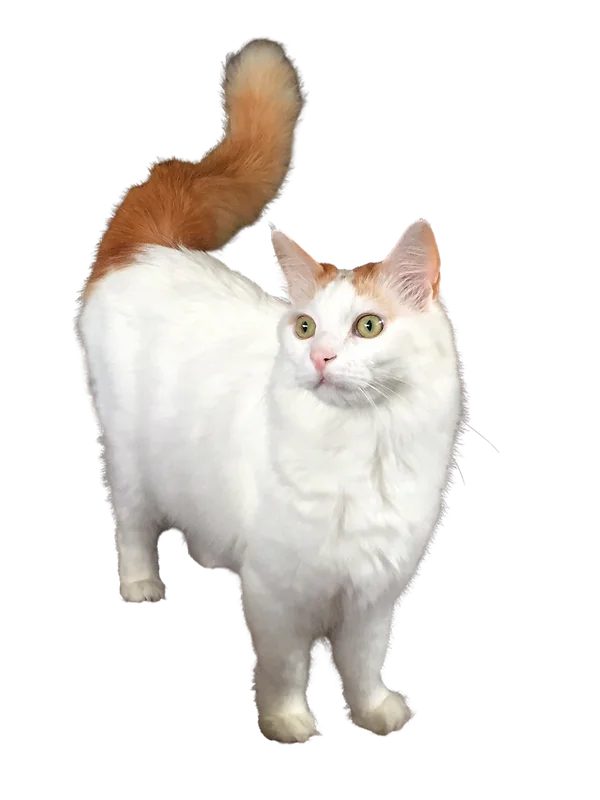 Featured phototurkish-van.jpg
The Turkish Van is a large semi-longhaired breed native to the Lake Van region of eastern Turkey, where it has lived as a distinctive regional cat for centuries. The breed was introduced to the United Kingdom in 1955 by British journalist Laura Lushington, who brought back two cats from a press trip to Turkey. GCCF recognized the Turkish Van in 1969; FIFe in 1971; TICA at its 1979 founding; and CFA granted championship status in 1994. The breed is notable for the Van pattern — coloured head and tail markings on an otherwise white body.
Quick facts
- Origin country
- Turkey (Lake Van region)
- Origin period
- Ancient regional breed; introduced to UK 1955; GCCF recognition 1969
- Coat type
- Long
- Coat colors
- Van pattern Red and White, Van pattern Cream and White, Van pattern Black and White, Van pattern Blue and White, Van pattern Tortoiseshell and White, Solid White
- Size category
- Large
- Average lifespan
- 12-17 years
- Recognition
- CFA 1994 · TICA 1979 · GCCF 1969 · FIFe 1971
Origin
The Turkish Van is a natural regional breed from eastern Anatolia, centred on the Lake Van basin — a high-altitude lake in modern-day Turkey. The breed has been present in the region for centuries and is regarded by some sources as among the oldest domestic cat populations in the Near East. The cats were introduced to Western cat fanciers in 1955 when British journalist Laura Lushington brought back two specimens from a Turkish press trip and established the UK foundation population from subsequent imports.
Recognition
The Governing Council of the Cat Fancy recognized the Turkish Van in 1969 following Lushington's sustained import and breeding programme. The Fédération Internationale Féline published its standard in 1971. The International Cat Association recognized the breed at its 1979 founding in Texas. The Cat Fanciers' Association granted championship status in 1994 after American breeders established an independent import line from Turkey.
Standard
The CFA and FIFe standards describe a large, muscular, long-bodied cat with a broad head, short nose, and large tufted ears. The coat is semi-long, silky, and single-layered — the Turkish Van has no woolly undercoat. The defining characteristic is the Van pattern: a chalk-white body with coloured markings confined to the head (around both eyes) and tail. The CFA recognizes red, cream, black, and blue as Van-pattern colours, with or without white blazes; the classic Van pattern is red and white.
Sources & further reading (3)
- registry-breed-profile — accessed 2026-04-30
- encyclopedia — accessed 2026-04-30
- gccf-registry — accessed 2026-04-30
Frequently asked questions
What is the Van pattern?
The Van pattern describes coloured markings confined to the head and tail on an otherwise white body. It is named for the Turkish Van breed in which it is the defining characteristic. The CFA recognizes red, cream, black, and blue as Van-pattern head and tail colours. The pattern appears in other breeds and is sometimes called 'harlequin' at low coverage percentages.
When was the Turkish Van recognized internationally?
The Governing Council of the Cat Fancy recognized the Turkish Van in 1969 following Laura Lushington's UK import programme. The FIFe published its standard in 1971. TICA recognized the breed at its 1979 founding. CFA granted championship status in 1994.
Is the Turkish Van the same as the Turkish Angora?
No. The Turkish Van and the Turkish Angora are distinct breeds with different origins, physical standards, and coat types. The Turkish Van is larger, originates from the Lake Van region of eastern Turkey, and is defined by its chalky-white body with coloured head and tail markings. The Turkish Angora originates from the Ankara region and carries a fine silky coat in a wide variety of colours without the Van-pattern requirement.