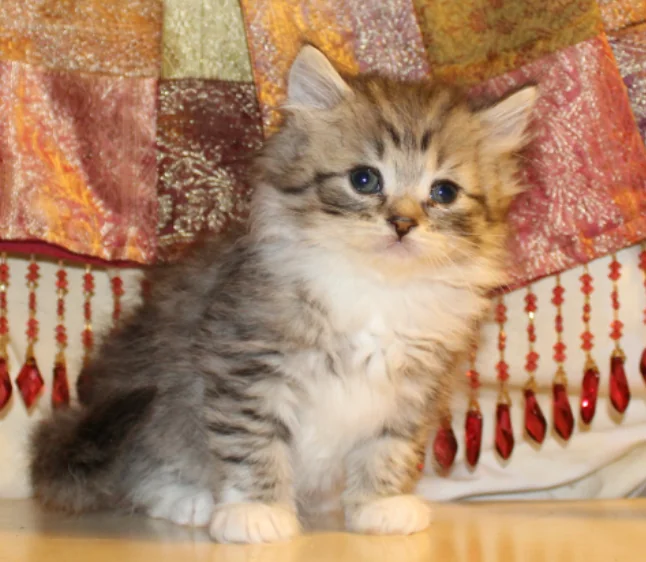
The RagaMuffin is a large, long-haired breed that originated as a breakaway group from Ann Baker's Ragdoll breeding programme in 1994. A group of breeders left Baker's International Ragdoll Cat Association (IRCA) and established the RagaMuffin breed to pursue mainstream registry recognition and a broader gene pool than Baker's closed IRCA system allowed. CFA granted championship status in 2011. TICA and other major registries have not published separate RagaMuffin standards.
Quick facts
- Origin country
- United States
- Origin period
- 1994 breakaway from Ragdoll breeding programme (Ann Baker IRCA); CFA championship 2011
- Coat type
- Long
- Coat colors
- All colours and patterns recognized including mink, sepia, and solid colours not accepted in the Ragdoll standard
- Size category
- Large
- Average lifespan
- 12-18 years
- Recognition
- CFA 2011
Origin
The RagaMuffin originated in 1994 when a group of breeders left Ann Baker's International Ragdoll Cat Association, which operated as a closed registry with licensing fees and restrictions Baker had established in the 1970s. The departing breeders formed a new breed to pursue recognition by mainstream registries. They admitted Persian, Himalayan, and domestic longhair outcrosses to diversify the gene pool — an option not available under Baker's closed IRCA system — producing a broader colour range and a slightly modified head type compared to the Ragdoll.
Recognition
CFA granted the RagaMuffin championship status in 2011 after a decade-long campaign by the breed's founders. TICA has not published a separate RagaMuffin standard; TICA-affiliated breeders show RagaMuffins under the Ragdoll standard or as a separate category in some regions. GCCF and FIFe have not published RagaMuffin standards. The breed is primarily shown in North America through CFA.
Standard
The CFA standard describes a large, heavy-boned, well-muscled cat that matures slowly over four or more years — similar to the Ragdoll. The head is a broad, modified wedge with a rounded, puffy appearance; the chin is fully developed. The coat is medium-long, dense, and plush — described as 'rabbit-like' in texture. The tail is long and full. All colours and patterns are recognized, including mink, sepia, and solid colours not accepted in the Ragdoll standard. The eyes are walnut-shaped and may be blue, green, gold, or odd-coloured — a broader eye colour range than the Ragdoll's blue-only requirement.
Sources & further reading (3)
- registry-breed-profile — accessed 2026-04-30
- encyclopedia — accessed 2026-04-30
- tica-standard — accessed 2026-04-30
Frequently asked questions
How does the RagaMuffin differ from the Ragdoll?
The RagaMuffin and Ragdoll share the same foundation stock but diverged in 1994 when a group of Ragdoll breeders left Ann Baker's closed registry. The RagaMuffin accepts a broader colour range including mink, sepia, and solid colours not permitted in the Ragdoll. The RagaMuffin's eye colour range includes blue, green, gold, and odd-coloured eyes — the Ragdoll requires blue eyes. The RagaMuffin head type may also differ slightly due to Persian and Himalayan outcrosses admitted after 1994.
When was the RagaMuffin recognized by CFA?
CFA granted the RagaMuffin championship status in 2011. TICA has not published a separate RagaMuffin standard. GCCF and FIFe have not recognized the breed.
Why was the breed named RagaMuffin instead of Ragdoll?
The 1994 breakaway group was unable to use the name Ragdoll because Ann Baker had trademarked the Ragdoll name through her International Ragdoll Cat Association. The breeders chose RagaMuffin as a related but legally distinct name. CFA accepted the RagaMuffin under this name at its 2011 championship recognition.