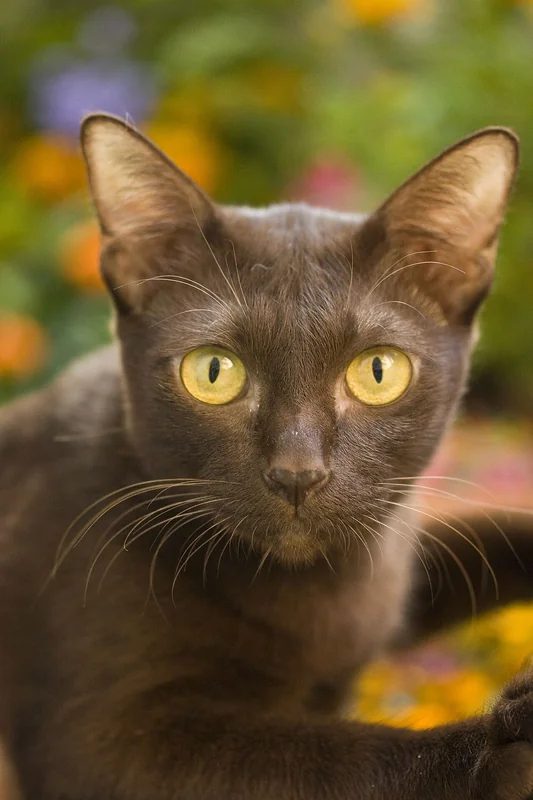
The Suphalak (Thai: Thong Daeng, 'copper') is an ancient Thai breed documented in the Tamra Maew manuscripts of the Ayutthaya Kingdom (1351-1767) alongside the Siamese, Korat, and Khao Manee as one of the auspicious cats of Thai royalty. The breed is solid copper-coloured (a warm reddish-brown) and was historically associated with prosperity and good fortune. Modern preservation efforts began in Thailand in the 1990s. TICA accepts the Suphalak for preliminary registration. CFA, GCCF, and FIFe have not published Suphalak standards.
Quick facts
- Origin country
- Thailand
- Origin period
- Ancient Thai breed documented in the 14th-19th-century Tamra Maew manuscripts; TICA preliminary
- Coat type
- Short
- Coat colors
- Solid copper-brown (the only recognized colour — warm reddish-brown described in the Tamra Maew as 'colour of polished copper')
- Size category
- Medium
- Average lifespan
- 12-15 years
- Recognition
- —
Origin
The Suphalak is documented in the Tamra Maew manuscripts of the Ayutthaya Kingdom (1351-1767) alongside the Siamese, Korat, and Khao Manee as one of the auspicious cats of Thai royalty. The Tamra Maew describes the Suphalak as 'colour of polished copper' (Thai: Thong Daeng), associating the breed with prosperity and royal favour. Through the 20th century the breed was nearly lost in Thailand as Western imports of Burmese and other Burmese-coloured breeds dominated the cat fancy. Modern preservation efforts began in Thailand in the 1990s, led by the Suphalak Cat Society in Bangkok.
Recognition
TICA accepts the Suphalak for preliminary registration in the new breed category. The breed has not yet advanced to championship status. CFA, GCCF, and FIFe have not published Suphalak standards. The breed is recognized in Thailand as a national heritage breed and is the subject of formal preservation efforts. The Suphalak is sometimes confused with the Burmese due to the shared warm-brown colour, but the two are distinct breeds — the Suphalak is a natural Thai breed without Burmese ancestry.
Standard
The TICA preliminary standard describes a medium-sized, well-muscled, moderate-foreign cat with a long body, slim legs, and a moderately wedge-shaped head. The defining characteristic is the coat colour: solid copper-brown, described in the Tamra Maew as 'colour of polished copper' — a warm reddish-brown without the Burmese sable's cooler tones. The eyes are golden to amber. The coat is short, fine, and close-lying with a glossy sheen. No other coat colour is accepted; the Suphalak is by definition a single-colour breed.
Sources & further reading (3)
- tica-standard — accessed 2026-04-30
- encyclopedia — accessed 2026-04-30
- encyclopedia — accessed 2026-04-30
Frequently asked questions
What does Suphalak mean?
Suphalak is a Thai word meaning 'auspicious' or 'fortune-bringing'. The breed is also called Thong Daeng — Thai for 'copper' — referring to the breed's distinctive solid copper-brown coat colour. Both names appear in the Tamra Maew manuscripts that document the breed's role as an auspicious cat of Thai royalty.
When was the Suphalak recognized internationally?
TICA accepts the Suphalak for preliminary registration in the new breed category. CFA, GCCF, and FIFe have not published Suphalak standards. The breed has not advanced to championship. Modern preservation efforts in Thailand began in the 1990s through the Suphalak Cat Society in Bangkok.
Is the Suphalak the same as the Burmese?
No. The Suphalak and the Burmese are distinct breeds despite the shared warm-brown coat colour. The Suphalak is a natural Thai breed documented in the Tamra Maew manuscripts since at least the 14th century. The Burmese is a 1930s-developed Western breed founded on a single Thai import (Wong Mau), but with no Suphalak ancestry. The two coats also differ in tone: the Suphalak is described as 'polished copper' (warm reddish), while the Burmese sable is a cooler dark brown.