Felis catus
Somali
 Featured photosomali.jpg
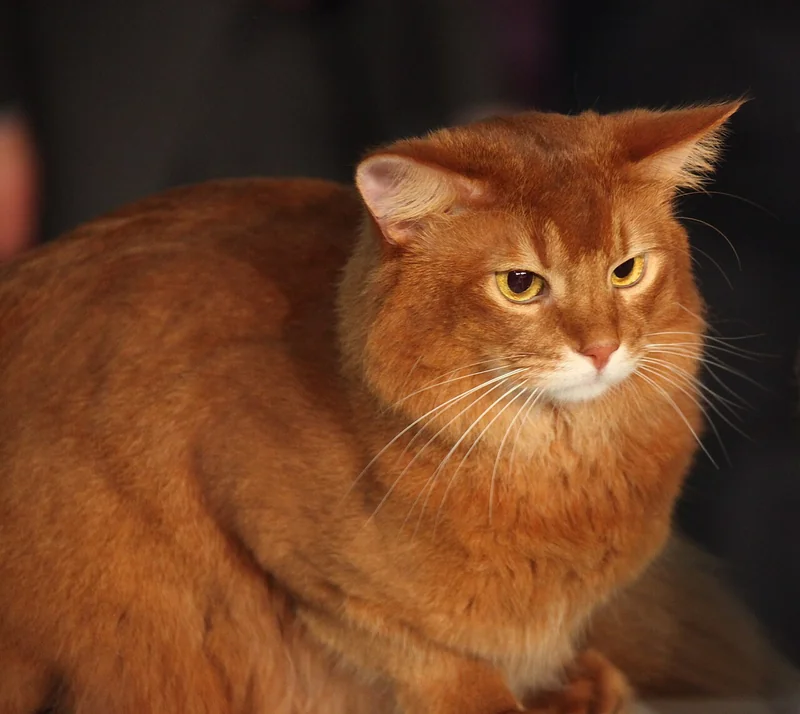
The Somali is a long-haired breed derived from the Abyssinian via a recessive longhair gene that appeared sporadically in Abyssinian litters throughout the 20th century. The modern breed programme was established by breeders in the United States, Canada, and Australia who independently developed the longhaired Abyssinian offspring into a separate standard. CFA granted championship in 1979; TICA at its 1979 founding; GCCF in 1983; and FIFe in 1982.
Quick facts
- Origin country
- United States / Canada / Australia
- Origin period
- 1960s–1970s long-haired Abyssinian offspring; CFA championship 1979
- Coat type
- Long
- Coat colors
- Ruddy (burnt sienna with black ticking), Red (warm red with chocolate ticking), Blue (warm blue-grey with steel-blue ticking), Fawn (warm rose-beige with cocoa ticking), Silver variants of each colour
- Size category
- Medium
- Average lifespan
- 11-16 years
- Recognition
- CFA 1979 · TICA 1979 · GCCF 1983 · FIFe 1982
Origin
Long-haired kittens appeared sporadically in Abyssinian litters throughout the 20th century due to the recessive longhair gene (l). American breeder Evelyn Mague formalized the breed in the United States in the 1960s, giving it the name Somali — adjacent to Abyssinia on the map of the Horn of Africa. Parallel development took place independently in Canada (Ken McGill) and Australia. The Somali is genetically an Abyssinian carrying two copies of the recessive longhair gene.
Recognition
CFA granted the Somali championship status in 1979 following development of a separate breed standard derived from the Abyssinian standard. TICA recognized the Somali at its 1979 founding. The Fédération Internationale Féline published its standard in 1982. The Governing Council of the Cat Fancy recognized the Somali in 1983. The breed is shown in the same colour classes as the Abyssinian plus silver variants.
Standard
The CFA standard describes a medium-sized, well-muscled cat with a foreign body type, a modified wedge head, and large ears set wide apart. The defining characteristic is the ticked agouti coat in the long-coat version: each hair has multiple bands of colour from base to tip, producing the characteristic 'wild' appearance. The tail is full and plumed. Recognized colours under CFA are ruddy, red, blue, and fawn, each with a distinctive ticking combination. TICA and FIFe additionally recognize silver variants. The Somali's double coat is medium-length, soft, and dense, with a pronounced ruff and breeches.
Sources & further reading (3)
- registry-breed-profile — accessed 2026-04-30
- encyclopedia — accessed 2026-04-30
- gccf-registry — accessed 2026-04-30
Frequently asked questions
Is the Somali a separate breed from the Abyssinian?
The Somali is genetically a long-haired Abyssinian — it carries two copies of the recessive longhair gene (l/l) in addition to the Abyssinian's ticked agouti coat genetics. CFA, TICA, GCCF, and FIFe maintain the Somali as a separate breed from the Abyssinian, with its own breed standard derived from the Abyssinian standard with coat-length modifications.
When was the Somali recognized?
CFA granted championship status in 1979. TICA recognized the Somali at its 1979 founding. FIFe published its standard in 1982. GCCF recognized the breed in 1983.
What colours are recognized for the Somali?
CFA recognizes four colours: ruddy (burnt sienna ground with black ticking), red (warm red with chocolate ticking), blue (warm blue-grey with steel-blue ticking), and fawn (warm rose-beige with cocoa ticking). TICA and FIFe additionally recognize silver variants of each base colour. All must display the characteristic multi-banded agouti ticking.