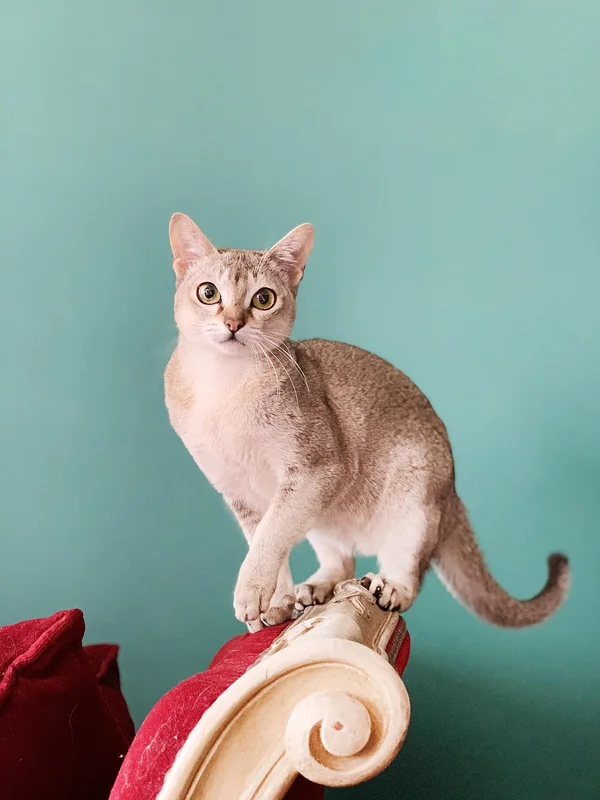
The Singapura is one of the smallest recognized domestic cat breeds, developed from street cats brought from Singapore to the United States in the 1970s by Tommy and Hal Meadow. The breed is known in Singapore as the 'Drain Cat' or 'Love Cat' and has been adopted by the Singapore Tourism Board as a national symbol. CFA granted championship status in 1988; TICA recognized the breed at its 1979 founding. The standard describes a small, muscular cat with a sepia-toned ticked coat and large eyes.
Quick facts
- Origin country
- Singapore
- Origin period
- 1970s (Tommy and Hal Meadow); CFA championship 1988
- Coat type
- Short
- Coat colors
- Sepia Agouti (the only recognized colour — warm ivory with dark brown ticking)
- Size category
- Small
- Average lifespan
- 11-15 years
- Recognition
- CFA 1988 · TICA 1979
Origin
The Singapura was developed from cats brought to the United States from Singapore by Tommy and Hal Meadow in 1975. The foundation stock comprised small, sepia-toned ticked cats that lived as street and drain cats in Singapore — hence the common name 'Drain Cat'. Singapore has since adopted the Singapura as a national symbol under the name Kucinta (Love Cat), and the Singapore Tourism Board has used stylized depictions of the breed in marketing materials.
Recognition
CFA received the Singapura in 1975 and granted provisional status in 1979; full championship status followed in 1988. The International Cat Association recognized the breed at its 1979 founding. Neither the GCCF nor FIFe maintains a separate Singapura breed register; the breed is primarily shown in North America and through TICA-affiliated bodies internationally. CFA conducted an origin investigation in 1990 and upheld the breed's Singapore provenance.
Standard
The CFA standard describes a small but muscular, well-built cat. The head is round with a medium-length broad muzzle and very large, slightly almond-shaped eyes — hazel, green, or yellow in colour. The coat is fine, short, and silky with a warm ivory ground and dark brown ticking on each hair shaft — the sepia agouti pattern. The only recognized colour under CFA and TICA is sepia agouti; no other colour is accepted for championship competition. The Singapura is consistently among the smallest recognized championship breeds by body weight.
Sources & further reading (3)
- registry-breed-profile — accessed 2026-04-30
- encyclopedia — accessed 2026-04-30
- tica-standard — accessed 2026-04-30
Frequently asked questions
Why is the Singapura so small?
The Singapura's small stature is regarded as a natural characteristic of the Singapore street-cat population from which the breed was developed. The CFA standard describes the breed as 'small to medium' but consistently at the lower end of the size range for recognized domestic cat breeds. Adult females commonly weigh as little as 1.8 kilograms.
When was the Singapura recognized by CFA?
CFA received the Singapura in 1975 and granted provisional status in 1979; full championship status followed in 1988. TICA recognized the breed at its 1979 founding. Neither GCCF nor FIFe maintains a separate Singapura register.
What is the Singapura's coat pattern?
The Singapura has a sepia agouti coat — a warm ivory ground with dark brown ticking on each hair shaft. This is the only colour recognized for championship competition under CFA and TICA. The ticking produces a warm, shimmering effect across the coat. The pattern is distinct from the spotted tabby of the Egyptian Mau and the ticked tabby of the Abyssinian in its specific sepia-brown colouration.