Felis catus
Korat
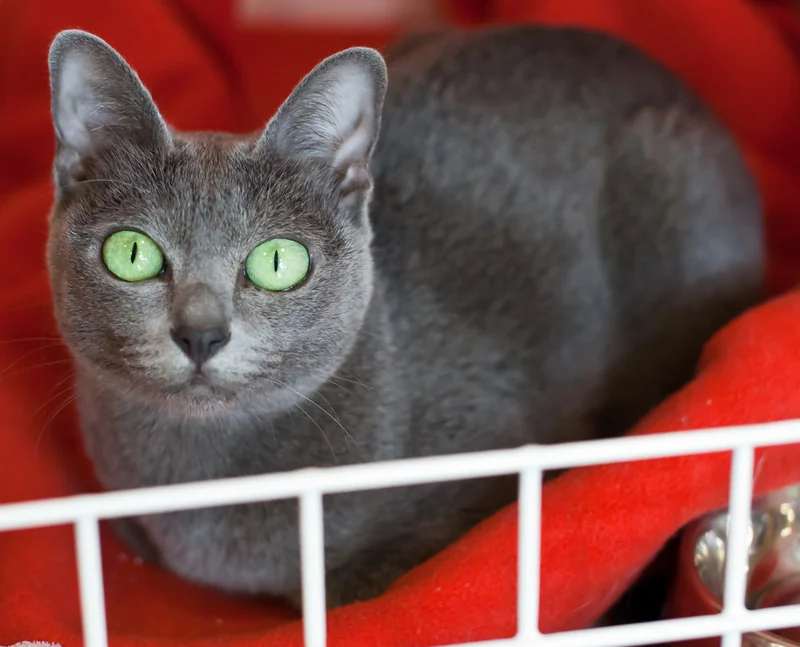 Featured photokorat.jpg
The Korat is a silver-blue short-haired breed native to the Korat plateau of northeastern Thailand, where it is known as the Si-Sawat ('colour of the sawat seed'). The breed is documented in the Tamra Maew, a series of Thai cat-poetry manuscripts produced between the 14th and 19th centuries. The first Korat pair reached the United States in 1959; CFA recognized the breed in 1967; GCCF in 1975; and TICA at its 1979 founding. The FIFe standard was published in 1982.
Quick facts
- Origin country
- Thailand (Korat plateau)
- Origin period
- Pre-19th century; documented in Tamra Maew; introduced to United States 1959
- Coat type
- Short
- Coat colors
- Silver-blue (the only recognized colour)
- Size category
- Small
- Average lifespan
- 10-15 years
- Recognition
- CFA 1967 · TICA 1979 · GCCF 1975 · FIFe 1982
Origin
The Korat is documented in the Tamra Maew — the series of Thai cat-poetry manuscripts produced during the Ayutthaya Kingdom between approximately the 14th and 19th centuries — as one of the breeds regarded as symbols of good fortune in Thai culture. The breed's name derives from the Korat plateau of northeastern Thailand (today's Nakhon Ratchasima province), where it is found as a natural population. The Si-Sawat colour — silver-blue with a silver-tipped coat — is described in the Tamra Maew illustrations.
Recognition
The first Korats reached the United States in 1959; the American Korat Cat Fanciers' Association was established in 1965. The Cat Fanciers' Association recognized the Korat in 1967. The Governing Council of the Cat Fancy admitted the breed in 1975 in the United Kingdom. The International Cat Association recognized the Korat at its 1979 founding, and the Fédération Internationale Féline published its standard in 1982.
Standard
The CFA and GCCF standards describe a medium-sized, semi-cobby, muscular cat with a distinctive heart-shaped head — one of the defining characteristics noted in both the Tamra Maew descriptions and the modern standard. The coat is single-layered, short, and glossy, with a silver-blue ground colour and silver-tipped guard hairs that produce a shimmering effect. The eyes are large, round, and peridot green in adults. The only recognized coat colour under all major registries is silver-blue; no other colour is accepted for championship competition.
Sources & further reading (3)
- registry-breed-profile — accessed 2026-04-30
- encyclopedia — accessed 2026-04-30
- gccf-registry — accessed 2026-04-30
Frequently asked questions
Is the Korat always silver-blue?
Yes. The CFA, TICA, GCCF, and FIFe standards all recognize only a single colour — silver-blue — for the Korat. The silver-tipped guard hairs over the blue ground coat produce a shimmering effect described in Thai folklore. 'Thai Blue Point' and 'Thai Lilac' cats that share the Korat body type but carry pointed or lilac coats are recognized by some registries as separate breeds.
What does 'Si-Sawat' mean?
Si-Sawat is the Thai name for the Korat, referring to the colour of the sawat fruit seed — a silver-blue stone. The name appears in the Tamra Maew manuscripts where the breed is described among the 'good fortune' cats. The Korat is still presented as gifts to newlyweds in some Thai communities.
When was the Korat introduced to the West?
The first Korat breeding pair reached the United States in 1959. The American Korat Cat Fanciers' Association was established in 1965, and CFA recognized the breed in 1967. The GCCF admitted it in 1975, making the Korat one of the earlier natural Asian breeds to gain formal Western registry recognition.