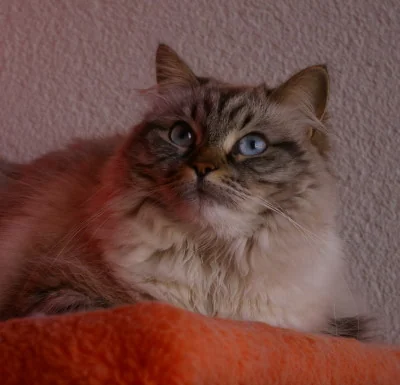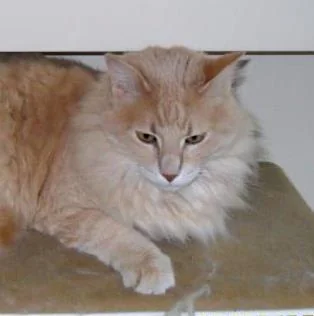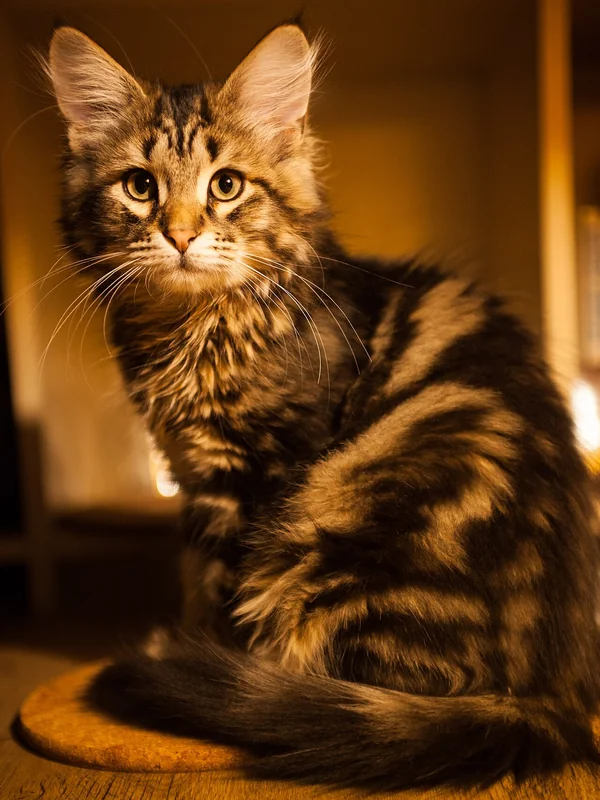
The Siberian is a natural long-haired breed indigenous to Russia, where it has lived for centuries as a forest and farm cat. The first Soviet-era cat club was the Kotofei Club founded in Moscow in 1987, providing the first formal breed documentation. International export began with the political opening of 1989-1990. TICA and FIFe both recognized the breed in 1992; GCCF in 2002; and CFA admitted the Siberian to championship status in 2006. The standard describes a large, powerful semi-longhaired cat with a triple-layered water-resistant coat.
Quick facts
- Origin country
- Russia
- Origin period
- Natural Russian forest breed; modern programme from 1987 (Kotofei Club Moscow)
- Coat type
- Long
- Coat colors
- Brown Tabby, Silver Tabby, Solid Black, Solid White, Solid Blue, Solid Red, Tortoiseshell, Bicolor, Smoke, Colorpoint (Neva Masquerade)
- Size category
- Large
- Average lifespan
- 11-15 years
- Recognition
- CFA 2006 · TICA 1992 · GCCF 2002 · FIFe 1992
Origin
The Siberian is a natural breed of the Russian taiga, indigenous to the forested regions of Siberia and northern Russia. References to long-haired Russian cats appear in 19th-century English texts; Harrison Weir's 1889 'Our Cats and All About Them' includes the Russian Longhair. Formal breed documentation began only in 1987 with the founding of the Kotofei Club in Moscow — the first cat club permitted in the Soviet Union. International export became possible with the political opening of 1989-1990, and the first Siberians arrived in the United States via Elizabeth Terrell's import in 1990.
Recognition
TICA recognized the Siberian in 1992; FIFe also recognized the breed in 1992 in continental Europe. The Governing Council of the Cat Fancy granted championship status in 2002 in the United Kingdom. The Cat Fanciers' Association admitted the Siberian to championship status in 2006 — the most recent major-registry recognition of the breed. The colourpoint variety, called the Neva Masquerade after the Neva River that flows through Saint Petersburg, is recognized as a colour division of the Siberian by FIFe and TICA.
Standard
The CFA standard describes a large, powerful, well-muscled cat with substantial bone and slow maturation over five years. The head is a modified wedge with rounded contours, broad cheekbones, and medium ears with prominent furnishings. The defining characteristic is the coat: a triple-layered water-resistant coat with a dense undercoat, awn hairs, and long guard hairs forming a full ruff and breeches. All traditional colours are recognized including the colourpoint Neva Masquerade variety. The tail is long and full.
Sources & further reading (3)
- registry-breed-profile — accessed 2026-04-30
- encyclopedia — accessed 2026-04-30
- gccf-registry — accessed 2026-04-30
Frequently asked questions
When was the Siberian recognized internationally?
TICA and FIFe both recognized the Siberian in 1992. GCCF granted championship status in 2002. CFA admitted the Siberian to championship in 2006. The breed had been formally documented in Russia from 1987 with the founding of the Kotofei Club in Moscow.
What is the Neva Masquerade?
The Neva Masquerade is the colourpoint variety of the Siberian, named for the Neva River that flows through Saint Petersburg. It carries the Siberian body type and triple-layered coat with Siamese-style point colouration. FIFe and TICA recognize it as a colour division of the Siberian; some registries treat it as a separate breed.
How large is a Siberian?
Adult males commonly weigh 6 to 9 kilograms; adult females weigh 4.5 to 6.5 kilograms. The breed matures slowly over approximately five years and is among the largest semi-longhaired breeds, alongside the Maine Coon, Norwegian Forest Cat, and Ragdoll.