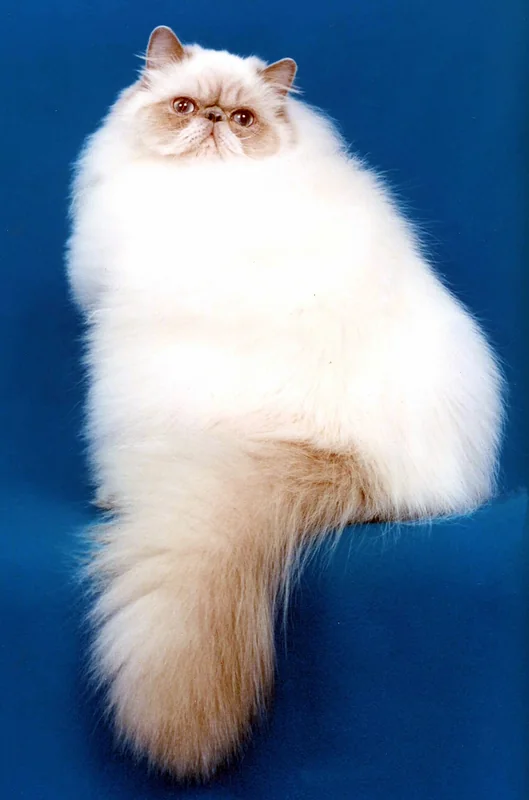
The Himalayan is a long-haired pointed breed developed in the 1930s by crossing Persian and Siamese cats to combine the Persian body type with Siamese point colouration. The programme was conducted at Harvard Medical School by Dr. Clyde Keeler and Virginia Cobb, with parallel work at Cambridge University. CFA recognized the Himalayan in 1957; TICA at its 1979 founding; GCCF and FIFe classify the breed as the Colourpoint Longhair rather than a separate breed.
Quick facts
- Origin country
- United States / United Kingdom
- Origin period
- 1930s development (Persian × Siamese; Harvard and Cambridge research); CFA recognition 1957
- Coat type
- Long
- Coat colors
- Seal Point, Blue Point, Chocolate Point, Lilac Point, Red Point, Cream Point, Tortoiseshell Point, Blue-cream Point, Lynx Point variants
- Size category
- Medium
- Average lifespan
- 9-15 years
- Recognition
- CFA 1957 · TICA 1979
Origin
The deliberate Persian x Siamese cross programme was conducted independently in the 1930s at Harvard Medical School by Dr. Clyde Keeler and Virginia Cobb, and at Cambridge University by Brian Stirling-Webb. Stirling-Webb produced the first Himalayan-type cat named Newton's Deeline in 1935. The goal was to combine the Persian body type and coat with the Siamese colour-point pattern. The programme required four or more generations of back-crosses to establish a cat that bred true for both Persian conformation and Siamese point colouration.
Recognition
CFA recognized the Himalayan as a separate breed in 1957. In 1984 CFA reclassified the Himalayan as a colour division of the Persian breed standard rather than a standalone breed — a status maintained by CFA today. TICA recognized the Himalayan as a separate breed at its 1979 founding and continues to do so. GCCF and FIFe classify the pointed long-haired cat as the Colourpoint Longhair under separate breed entries.
Standard
The CFA Persian division standard (which applies to the Himalayan colourpoint division) describes a cobby, heavy-boned, large cat with a round massive head and brachycephalic conformation — the same standard as the Persian. The coat is long, thick, and flowing. The colour is restricted to the Himalayan or colour-point pattern: pale body with darker points at the face mask, ears, legs, and tail. Point colours recognized include the traditional four (seal, blue, chocolate, lilac), red, cream, tortoiseshell, and lynx point variants. TICA's Himalayan standard is similar but maintained separately from the Persian.
Sources & further reading (3)
- registry-breed-profile — accessed 2026-04-30
- encyclopedia — accessed 2026-04-30
- tica-standard — accessed 2026-04-30
Frequently asked questions
Is the Himalayan a separate breed from the Persian?
CFA currently classifies the Himalayan as a colour division of the Persian, a reclassification made in 1984. TICA recognizes the Himalayan as a distinct breed. GCCF and FIFe use the separate breed name Colourpoint Longhair for the pointed long-haired cat. The practical distinction is in registry classification; the cats are physically identical in type to the Persian and are shown together in CFA under the Persian breed standard.
When was the Himalayan recognized by CFA?
CFA recognized the Himalayan as a separate breed in 1957. In 1984 CFA reclassified it as a colour division of the Persian. TICA recognized the Himalayan at its 1979 founding and continues to treat it as a separate breed.
What point colours are recognized for the Himalayan?
Under the CFA Persian colour-point division, recognized colours include seal, blue, chocolate, lilac, red, cream, tortoiseshell, blue-cream, chocolate-tortoiseshell, lilac-cream, and all lynx-point variants of the above. The body is pale in all cases; point contrast is required. TICA's Himalayan standard recognizes the same range of point colours.