Yucca gigantea
Yucca gigantea (Spineless Yucca) Care Guide
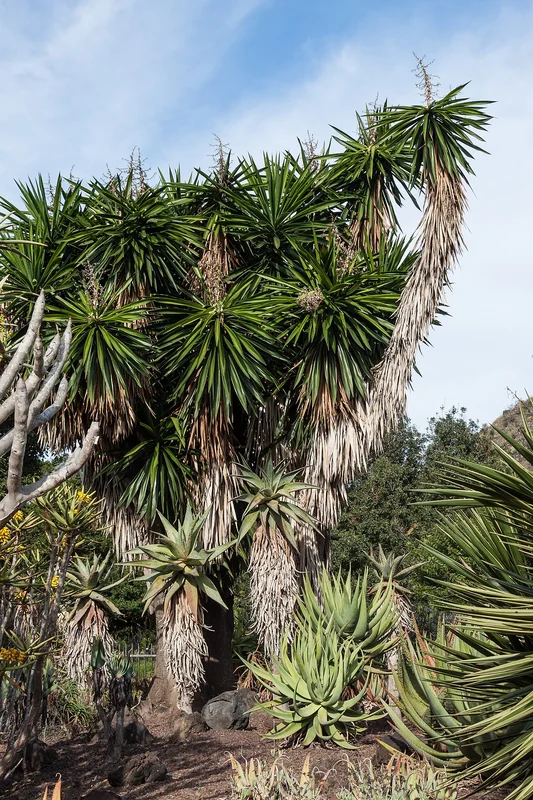 Featured photoyucca-elephantipes.jpg
Yucca gigantea, sold as the spineless yucca (and historically as Y. elephantipes), is a Central American Yucca with thick woody trunks and rosettes of long arching strap-like green leaves at the top of each trunk. Tolerates a wide range of indoor conditions and is one of the most architectural cultivated yuccas.
Care facts at a glance
- Light
- Bright indirect
- Water
- Water deeply when the top 5 cm of mix has dried.
- Humidity
- 30–50 %
- Temperature
- 15–27 °C
- Soil
- Free-draining loamy mix with extra perlite or pumice.
- Origin
- Lowland Central America from Mexico to Honduras.
- Mature size
- 1.5 to 2.5 m tall indoors; up to 9 m in habitat.
Overview
Yucca gigantea is a Central American monocot in Asparagaceae, related to Beaucarnea and the agaves rather than to the cycads or palms it sometimes resembles. The species was long known as Y. elephantipes (a name still common in the trade) but modern taxonomy reinstates the older Y. gigantea. The 'spineless' name refers to the soft leaf tips of this species, unlike the sharp-tipped desert Yuccas.
Care Priorities
- Bright filtered light or several hours of direct sun.
- Free-draining loamy mix.
- Water deeply, then let the top 5 cm dry.
- Tolerates cool winter temperatures down to 5 °C briefly.
Common Problems
Yellow lower leaves are normal aging — trim at the base. Soft trunk base is overwatering and is usually fatal. Brown leaf tips signal dry air or fluoride in tap water; switch to filtered or rainwater.
Sources & further reading (2)
- encyclopedia — accessed 2026-04-29
- botanical-garden — accessed 2026-04-29
Frequently asked questions
Is Y. gigantea the same as Y. elephantipes?
Yes — modern taxonomy reinstates the older name Y. gigantea, but the species is still very widely sold as Y. elephantipes at retail. Both names refer to the same plant.
Why are the leaf tips soft?
Y. gigantea has soft flexible leaf tips, unlike the sharp rigid tips of desert Yuccas like Y. aloifolia. The soft tips give the trade name 'spineless yucca' and make the species safer to handle and position indoors.
Can I cut it back if it gets too tall?
Yes — Yucca tolerates pruning well. Cut the trunk where you want a new leaf rosette to form; the plant typically pushes one or two new shoots from the cut over a few months. Use the removed trunk section as a stem cutting in moist mix.