Syngonium rayii
Syngonium rayii (Ray's Arrowhead) Care Guide
 Featured photosyngonium-rayii.jpg
Syngonium rayii, sold as Ray's Arrowhead, is a member of *Syngonium*, an Araceae genus of about 30 climbing species across tropical America. A Panamanian Syngonium with elongated leaves marked in a bright silver-white midrib stripe on a dark green base, the silver intensifying in bright filtered light. Smaller-leaved than the more common S. podophyllum. Like all Syngonium it produces two distinct leaf forms — juvenile arrow-shaped leaves on free-standing plants and divided multi-lobed mature leaves on climbing stems.
Care facts at a glance
- Light
- Bright indirect
- Water
- Water when the top 2 to 3 cm of mix has dried.
- Humidity
- 50–70 %
- Temperature
- 18–27 °C
- Soil
- Free-draining houseplant mix with extra perlite or bark.
- Origin
- Tropical Central and South America, mostly Mexico to Bolivia.
- Mature size
- Vining stems to 2 m on a moss pole.
Overview
Syngonium rayii sits in Syngonium, a Neotropical climbing aroid genus. A Panamanian Syngonium with elongated leaves marked in a bright silver-white midrib stripe on a dark green base, the silver intensifying in bright filtered light. Smaller-leaved than the more common S. podophyllum. The juvenile arrow-shaped leaves typical of pot specimens give way to deeply lobed mature leaves once the plant climbs and reaches a stable rooting structure on a tree or pole.
Care Priorities
- Bright filtered light supports vivid leaf colour.
- Free-draining houseplant mix.
- Water when the top 2 to 3 cm of mix is dry.
- Provide a moss pole — Syngonium produces larger, lobed mature leaves when climbing.
Common Problems
Pale or fading colour signals insufficient light. Yellow leaves are usually overwatering. Brown leaf edges signal dry air.
Sources & further reading (2)
- encyclopedia — accessed 2026-04-29
- botanical-garden — accessed 2026-04-29
Frequently asked questions
How is S. rayii different from S. podophyllum?
Both are Central American Syngonium, but S. rayii has a single bold silver midrib stripe on smaller darker leaves, while S. podophyllum carries pale variegation distributed across the leaf surface. S. rayii also stays more compact in cultivation, rarely exceeding 1 m on a moss pole.
Why does the leaf shape change?
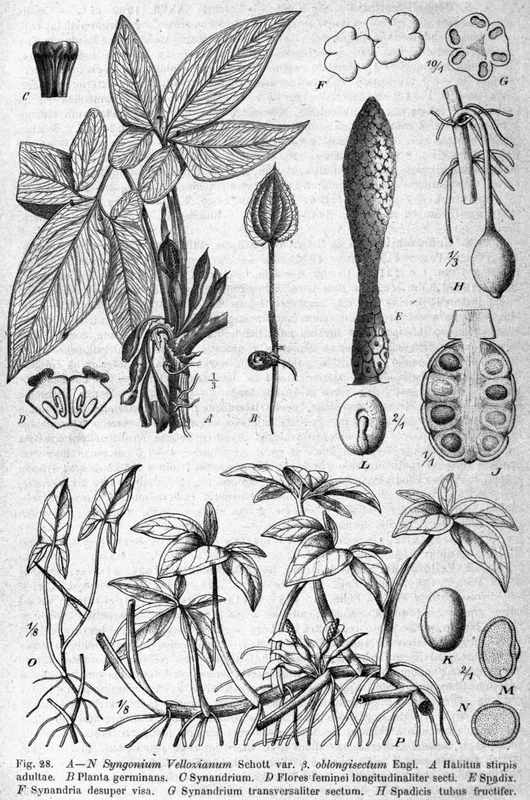
Syngonium produces two distinct leaf morphologies — juvenile arrow-shaped leaves on free-standing plants and divided multi-lobed mature leaves on climbing stems. The shift happens once the plant has a moss pole or trellis and accumulates climbing height.
Can I root cuttings in water?
Yes — Syngonium roots easily in water. Cut a stem section with at least one node and one aerial root, place in water, and pot up once roots reach 3 to 5 cm long.