Syngonium erythrophyllum
Syngonium erythrophyllum (Red-Leaf Arrowhead) Care Guide
 Featured photosyngonium-erythrophyllum.jpg
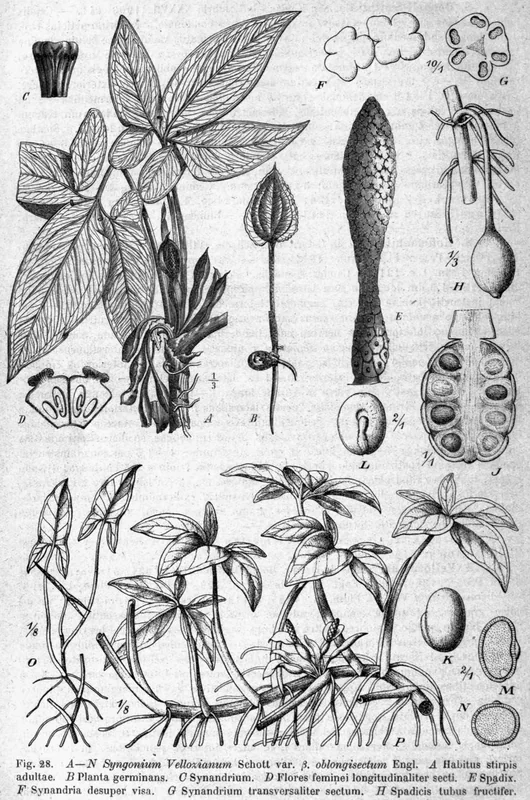
Syngonium erythrophyllum, sold as Red-Leaf Arrowhead, is a member of *Syngonium*, an Araceae genus of about 30 climbing species across tropical America. A Panamanian and Costa Rican Syngonium with leaves green on the upper surface and intense burgundy-red on the underside, the contrast visible whenever the climbing stems lift the leaf on a moss pole. Like all Syngonium it produces two distinct leaf forms — juvenile arrow-shaped leaves on free-standing plants and divided multi-lobed mature leaves on climbing stems.
Care facts at a glance
- Light
- Bright indirect
- Water
- Water when the top 2 to 3 cm of mix has dried.
- Humidity
- 50–70 %
- Temperature
- 18–27 °C
- Soil
- Free-draining houseplant mix with extra perlite or bark.
- Origin
- Tropical Central and South America, mostly Mexico to Bolivia.
- Mature size
- Vining stems to 2 m on a moss pole.
Overview
Syngonium erythrophyllum sits in Syngonium, a Neotropical climbing aroid genus. A Panamanian and Costa Rican Syngonium with leaves green on the upper surface and intense burgundy-red on the underside, the contrast visible whenever the climbing stems lift the leaf on a moss pole. The juvenile arrow-shaped leaves typical of pot specimens give way to deeply lobed mature leaves once the plant climbs and reaches a stable rooting structure on a tree or pole.
Care Priorities
- Bright filtered light supports vivid leaf colour.
- Free-draining houseplant mix.
- Water when the top 2 to 3 cm of mix is dry.
- Provide a moss pole — Syngonium produces larger, lobed mature leaves when climbing.
Common Problems
Pale or fading colour signals insufficient light. Yellow leaves are usually overwatering. Brown leaf edges signal dry air.
Sources & further reading (2)
- encyclopedia — accessed 2026-04-29
- botanical-garden — accessed 2026-04-29
Frequently asked questions
Why is the leaf underside red?
S. erythrophyllum leaves carry intense anthocyanin pigmentation on the underside that contrasts with the green upper surface. The species' name (*erythrophyllum* meaning 'red-leaved') refers to that colour. The contrast is most visible when stems climb and lift the leaves above eye level.
Why does the leaf shape change?
Syngonium produces two distinct leaf morphologies — juvenile arrow-shaped leaves on free-standing plants and divided multi-lobed mature leaves on climbing stems. The shift happens once the plant has a moss pole or trellis and accumulates climbing height.
Can I root cuttings in water?
Yes — Syngonium roots easily in water. Cut a stem section with at least one node and one aerial root, place in water, and pot up once roots reach 3 to 5 cm long.