Sinningia speciosa
Sinningia speciosa (Florist's Gloxinia) Care Guide
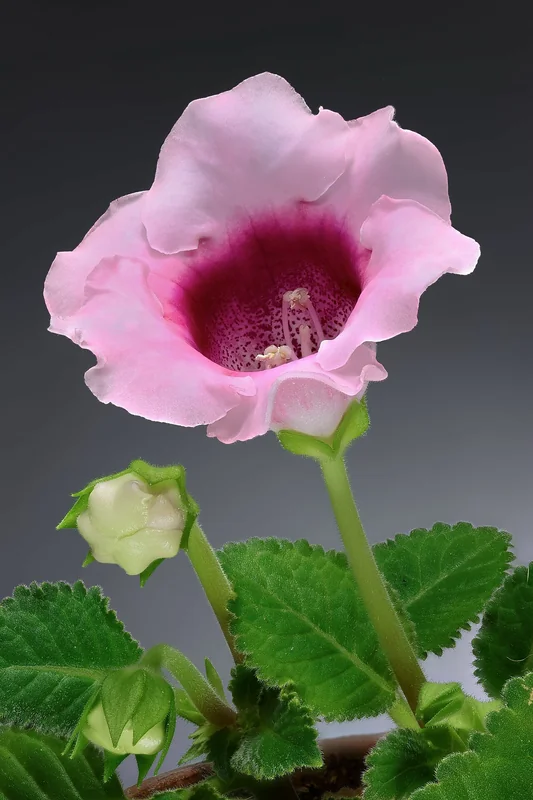 Featured photosinningia-speciosa.jpg
Sinningia speciosa, sold as the florist's gloxinia, is a Brazilian gesneriad with broad fuzzy oval leaves arranged in a low rosette and tall stalks of large bell-shaped flowers in red, pink, purple, or white. Mature plants grow from a tuberous rhizome that rests underground after flowering.
Care facts at a glance
- Light
- Bright indirect
- Water
- Water when the top 1 to 2 cm of mix has dried during active growth.
- Humidity
- 50–70 %
- Temperature
- 16–24 °C
- Soil
- Light gesneriad mix with peat or coir and extra perlite for aeration.
- Origin
- Atlantic forest of south-eastern Brazil.
- Mature size
- 20 to 30 cm tall and wide.
Overview
Sinningia speciosa belongs to Sinningia, a Brazilian gesneriad genus closely related to African violets and Streptocarpus. The species grows from a tuberous rhizome that rests dormant for several months between flowering cycles, which is why mature plants seem to disappear and reappear over the year.
Care Priorities
- Bright filtered light during active growth.
- Even moisture; never let the crown sit wet.
- Reduce watering sharply once leaves yellow at season end — the tuber rests dormant.
- Re-pot the dormant tuber in fresh mix in early spring before sprouting.
Common Problems
Leaf yellowing late in the season is normal dormancy onset, not disease. Crown rot from water sitting in the rosette is the leading killer. Pale weak growth in subsequent seasons usually means the tuber is too crowded — divide and re-pot.
Sources & further reading (2)
- encyclopedia — accessed 2026-04-29
- botanical-garden — accessed 2026-04-29
Frequently asked questions
Why did my gloxinia 'die' suddenly?
Sinningia speciosa enters a true dormancy after flowering — the leaves yellow and die back, leaving only the underground tuber. Stop watering, store the dry tuber cool, and re-pot in fresh mix in early spring to trigger the next flowering cycle.
How long does each flowering cycle last?
Mature S. speciosa plants typically bloom for 6 to 8 weeks in late spring or summer, producing a succession of bell-shaped flowers. Once flowering ends, the dormancy phase begins and the leaves die back over a few weeks.
Will the same tuber bloom again next year?
Yes — S. speciosa tubers persist for many years and bloom annually with proper dormancy management. Tubers may also be divided every 2 to 3 years in spring to multiply the plant.