Curio rowleyanus
Senecio rowleyanus (String of Pearls) Care Guide
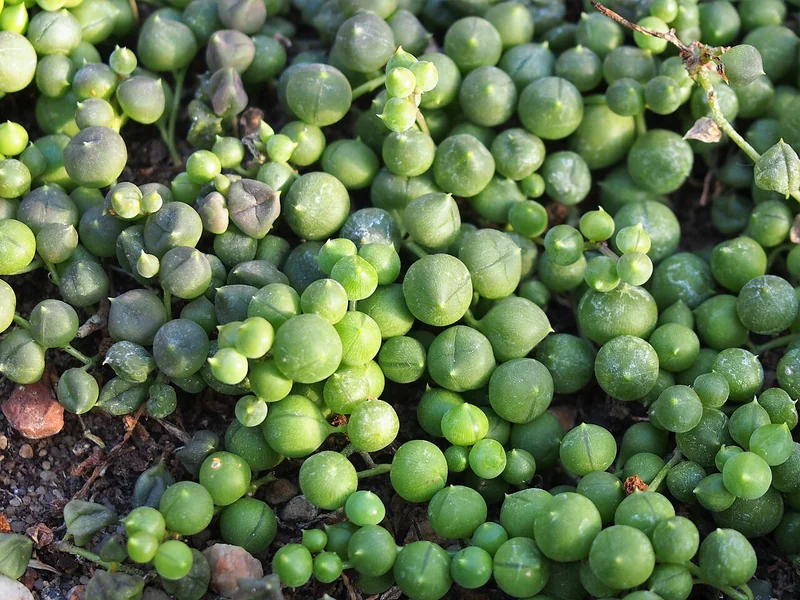 Featured photosenecio-rowleyanus.jpg
Senecio rowleyanus, now formally Curio rowleyanus, is the string of pearls — a Namibian succulent with spherical pea-shaped leaves clustered along extremely thin trailing stems. The pearls have a translucent slit on one side that lets light into the deeper photosynthetic tissue. It is a striking hanging-pot succulent but one of the more rot-prone, requiring sharp drainage and restraint with water.
Care facts at a glance
- Light
- Full sun
- Water
- Water deeply only when the mix is fully dry; typically every 2 to 3 weeks.
- Humidity
- 30–50 %
- Temperature
- 15–27 °C
- Soil
- Free-draining cactus or succulent mix with extra perlite or pumice.
- Origin
- Southwestern Africa, especially Namibia.
- Mature size
- Trailing stems to 60 to 90 cm long.
Overview
Senecio rowleyanus was reclassified into Curio in the 2010s but the older name persists in trade. The translucent slit on each pearl is an adaptation to deep-shade habitats where the round leaves reduce surface area for water loss.
Care Priorities
- Full sun or very bright filtered light.
- Sharp drainage; rot is the textbook string-of-pearls failure.
- Water deeply when fully dry, then leave alone.
- Hanging pot displays the trailing stems naturally.
Common Problems
Mushy strands at the soil line are overwatering. Wrinkled pearls are extreme drought. Long bare stems are leggy growth from low light.
Sources & further reading (2)
- encyclopedia — accessed 2026-04-28
- botanical-garden — accessed 2026-04-28
Frequently asked questions
Why is it so hard to keep alive?
String of pearls is one of the most rot-prone succulents. Sharp drainage, full sun, and very restrained watering solve almost all common problems.
Senecio or Curio?
Botanically Curio rowleyanus since the 2010s reclassification. Trade still uses Senecio rowleyanus widely.
Why are my pearls shrivelling?
Either extreme drought (most common) or root rot (second most common). Check the soil — dry pot means water; wet pot means rot.