Sempervivum arachnoideum
Sempervivum arachnoideum (Cobweb Houseleek) Care Guide
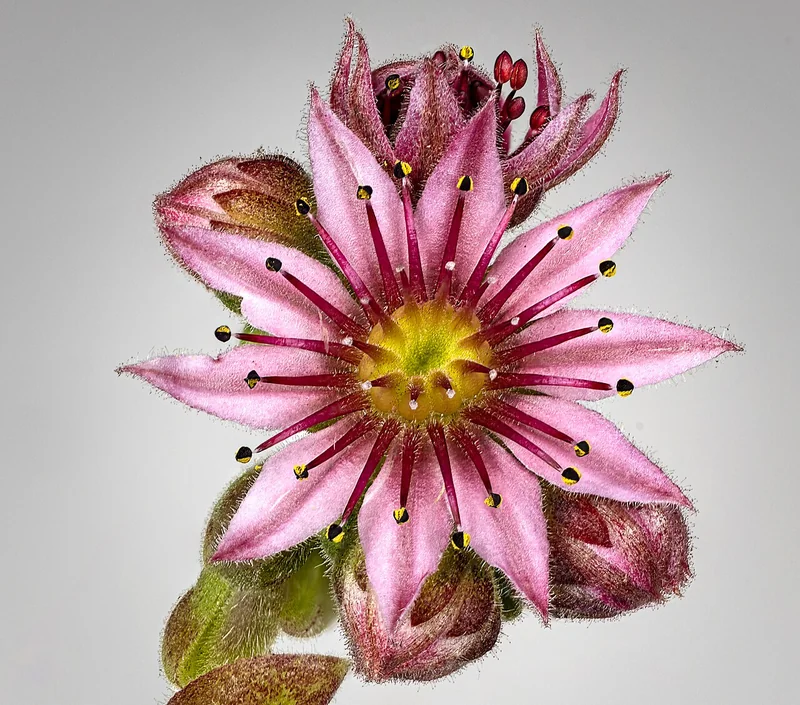 Featured photosempervivum-arachnoideum.jpg
Sempervivum arachnoideum, sold as Cobweb Houseleek, is a rosette succulent in Crassulaceae. A high-altitude European rosette succulent with small green leaves connected by fine white threads spun between leaf tips, looking like a thin cobweb across each rosette. Like most members of its group it forms tight rosettes of thick fleshy leaves, tolerates long dry spells thanks to its water-storing tissue, and propagates readily from leaves or offsets.
Care facts at a glance
- Light
- Full sun
- Water
- Water deeply when the mix is fully dry.
- Humidity
- 20–50 %
- Temperature
- 5–27 °C
- Soil
- Free-draining gritty cactus mix with extra perlite or pumice.
- Origin
- Alpine zones of the Pyrenees, Alps, and Carpathians.
- Mature size
- 5 to 30 cm tall and wide depending on species.
Overview
Sempervivum arachnoideum sits in Crassulaceae, the same family as Sedum and Echeveria. A high-altitude European rosette succulent with small green leaves connected by fine white threads spun between leaf tips, looking like a thin cobweb across each rosette. The thick succulent leaves store water reserves and the typical rosette architecture maximises sun capture in the species' open native habitats.
Care Priorities
- Full sun or very bright filtered light to keep rosettes compact.
- Free-draining gritty mix.
- Water deeply, then let the mix dry fully.
- Detach offsets to keep colonies tidy and propagate.
Common Problems
Stretched, pale rosettes are insufficient light. Mushy base is overwatering. Brown leaf tips are usually old age and harmless.
Sources & further reading (2)
- encyclopedia — accessed 2026-04-29
- botanical-garden — accessed 2026-04-29
Frequently asked questions
What are the white threads on the rosette?
S. arachnoideum produces fine white silk-like fibres connecting the leaf tips of each rosette — the threads are produced by specialised glands and may help capture moisture from alpine fog. The species' name (*arachnoideum* meaning 'spider-web like') refers to the cobweb appearance.
Why is the rosette stretching upward?
Stretched, elongated rosettes indicate insufficient light. Most rosette succulents need direct sun for at least a few hours a day to stay tight; in dim conditions they reach for the brightest light and lose their compact shape.
Can I propagate from a single leaf?
Yes — most rosette succulents propagate readily from leaves. Twist a healthy leaf cleanly off the rosette, callus the wound for a day or two, and lay it on dry succulent mix. Roots and a new rosette typically appear within a few weeks.