Pellionia pulchra
Pellionia pulchra (Satin Pellionia) Care Guide
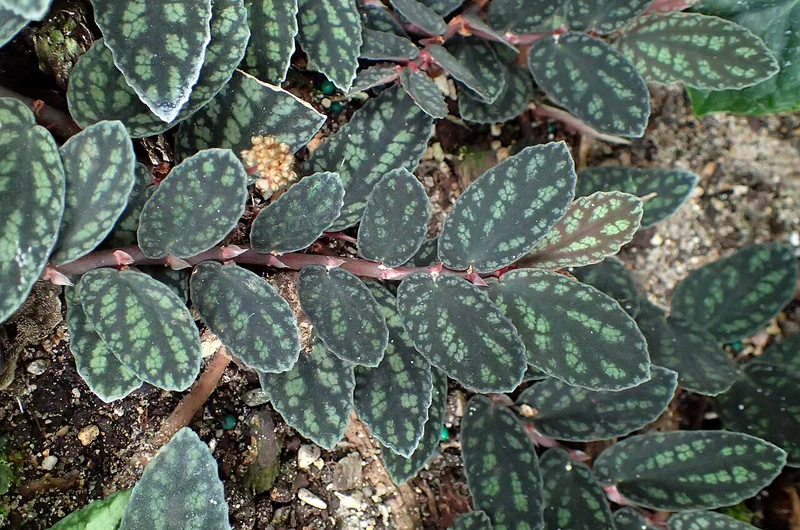 Featured photopellionia-pulchra.jpg
Pellionia pulchra, sold as the satin pellionia, is a south-east Asian Urticaceae creeping plant with rounded silver-grey leaves marked by darker green leaf veins, the contrast giving an unusual satin texture. Now formally Procris pulchra in modern taxonomy, but still widely sold under the older Pellionia name.
Care facts at a glance
- Light
- Bright indirect
- Water
- Water when the top 2 cm of mix has dried.
- Humidity
- 60–80 %
- Temperature
- 18–27 °C
- Soil
- Light, free-draining peat-rich mix with perlite.
- Origin
- Tropical south-east Asia, especially Vietnam and Myanmar.
- Mature size
- Trailing stems to 30 cm.
Overview
Pellionia pulchra belongs to Urticaceae, the nettle family, and is closely related to Pilea. Modern molecular taxonomy places the species in Procris (as P. pulchra), but plants are still widely sold under the older Pellionia name. The patterned silver-grey leaves with darker green venation are the species' distinguishing feature.
Care Priorities
- Bright filtered light to keep leaf patterning vivid.
- Steady warm temperatures above 18 °C.
- High humidity above 60 percent prevents leaf crisping.
- Use a small pot — Pellionia roots resent excess soil volume.
Common Problems
Crispy leaf edges signal dry indoor air. Pale or fading colour signals insufficient light. Sudden leaf drop after a temperature swing is a normal stress response — new growth follows once conditions stabilise.
Sources & further reading (2)
- encyclopedia — accessed 2026-04-29
- botanical-garden — accessed 2026-04-29
Frequently asked questions
Is this Pellionia or Procris?
Modern Kew taxonomy reclassified *Pellionia* into *Procris*, so the formal name is now P. pulchra (Procris pulchra). Plants are still widely sold under the older Pellionia name; both names refer to the same species.
How is this related to Pilea?
Pellionia/Procris and Pilea are closely related — both sit in Urticaceae, the nettle family. Pilea is more widely cultivated indoors, but the two genera share the creeping habit and similar care requirements.
Why are the leaves patterned in silver?
P. pulchra leaves carry pale silver tissue between darker green veins, giving the satin-textured pattern. The pigmentation is genetic and species-typical; light intensity affects the contrast but not the underlying pattern.