Monstera dubia
Monstera dubia (Shingle Plant) Care Guide
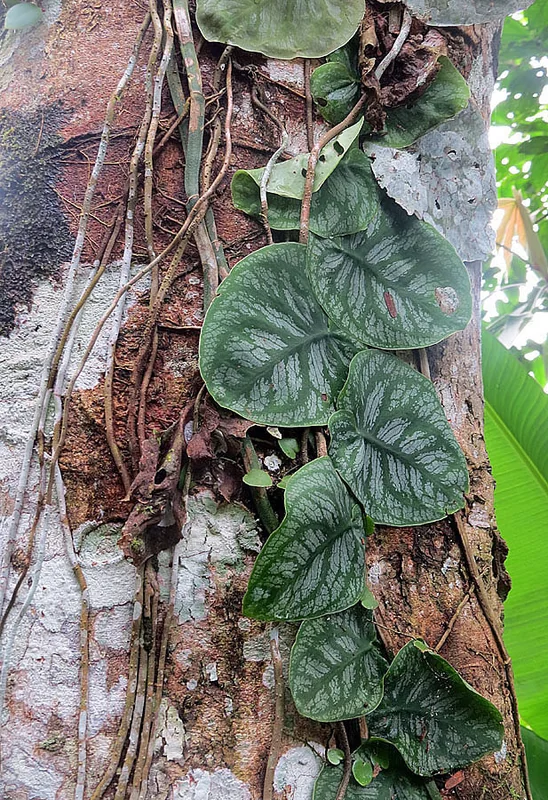 Featured photomonstera-dubia.jpg
Monstera dubia spends years as a juvenile shingling vine — flat, silver-marked leaves pressed tight against tree bark or a wooden plank. Once it reaches the canopy it transforms dramatically into a fenestrated adult with large, perforated leaves more typical of the genus. Most indoor plants stay in juvenile form and are grown for that distinctive flat, ivy-like climbing habit.
Care facts at a glance
- Light
- Bright indirect
- Water
- Water when the top 2 cm of mix dries; the plank or moss surface should stay just slightly moist.
- Humidity
- 60–80 %
- Temperature
- 18–27 °C
- Soil
- Plank-mounted with sphagnum, or a chunky aroid mix in a small pot at the base of a plank.
- Origin
- Rainforests of Central and South America, from Mexico to Bolivia.
- Mature size
- Juvenile vines 1 to 2 metres on a plank; adult phase rarely seen in cultivation.
Overview
Monstera dubia is unusual for showing two completely different leaf forms. Juvenile plants press small, silver-veined heart-shaped leaves flat against a vertical surface in a shingled pattern; adults free-climb with large fenestrated leaves. The juvenile phase is what most people grow.
Care Priorities
- Give it a flat, porous climbing surface — a moss-wrapped plank, cork bark, or untreated wood.
- Keep humidity high, especially near the climbing surface.
- Light moisture rather than heavy watering — wet bark rots roots.
- Pin straying leaves back to the surface until aerial roots take hold.
Common Problems
Leaves lifting off the surface usually mean the support is too dry; mist the back of the plank. Yellowing is overwatering. Stalled climbing growth points to too little humidity or a surface the aerial roots cannot grip.
Sources & further reading (2)
- encyclopedia — accessed 2026-04-28
- botanical-garden — accessed 2026-04-28
Frequently asked questions
Will it ever turn into the adult fenestrated form?
Rarely indoors. The transition needs years of vertical climbing space and high light at the top of the climb.
Best mounting surface?
Cork bark or a moss pole works; many growers use a flat cedar plank wrapped in damp sphagnum for the cleanest shingled look.
Why is my dubia not flattening to the surface?
The aerial roots need contact with a moist, porous surface. A plain wooden board with no moss often will not work — wrap it in sphagnum.