Hoya coronaria
Hoya coronaria (Crown Hoya) Care Guide
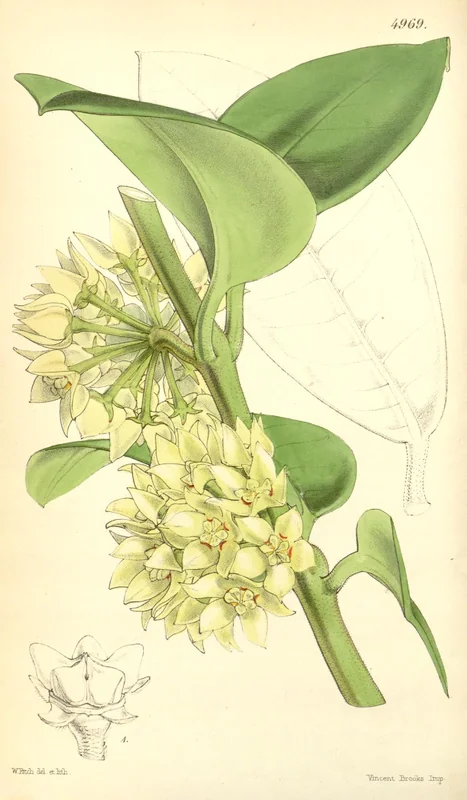 Featured photohoya-coronaria.jpg
Hoya coronaria is a Southeast Asian hoya with thick, fuzzy, succulent leaves and dramatic flat-faced flowers — among the largest in the entire genus, reaching 5 cm across with bold pink to red colour. The hairy leaf surface gives the plant a velvety look. It is more cold-sensitive than typical hoyas and prefers steady warmth and bright filtered light.
Care facts at a glance
- Light
- Bright indirect
- Water
- Water when the top 3 cm of mix has dried.
- Humidity
- 50–70 %
- Temperature
- 18–29 °C
- Soil
- Very free-draining mix of bark, perlite, and a small fraction of coir.
- Origin
- Coastal forests of Borneo, Sulawesi, and the Philippines.
- Mature size
- Vines to 2 metres indoors with support.
Overview
Hoya coronaria was described in the 1840s and is one of the most variable hoyas in flower colour, with white, pink, red, and yellow forms in cultivation. Coronaria has 5 to 7 large flowers per cluster rather than the dozens of small flowers in typical hoyas.
Care Priorities
- Steady warmth above 18 °C; coronaria is more cold-sensitive than carnosa.
- Bright filtered light or a few hours of direct sun.
- Sharply draining mix; coronaria rots fast in soggy soil.
- Higher humidity than typical hoyas suits the velvet leaves.
Common Problems
Yellow leaves with mushy bases is overwatering. No flowers usually means too little light or insufficient maturity — coronaria can take 2 to 3 years to first bloom. Cold draughts cause leaf drop.
Sources & further reading (2)
- encyclopedia — accessed 2026-04-28
- botanical-garden — accessed 2026-04-28
Frequently asked questions
How big are the flowers?
Up to 5 cm across — among the largest in the entire genus. Each cluster has only 5 to 7 flowers rather than the dozens of typical hoyas.
Why are my leaves fuzzy?
Coronaria has hairy leaves, which is species-typical. Most other hoyas have glabrous (smooth) leaves.
Is it harder to grow than carnosa?
Slightly — coronaria is more cold-sensitive and slightly more rot-prone. Otherwise care is similar.