Episcia cupreata
Episcia cupreata (Flame Violet) Care Guide
 Featured photoepiscia-cupreata.jpg
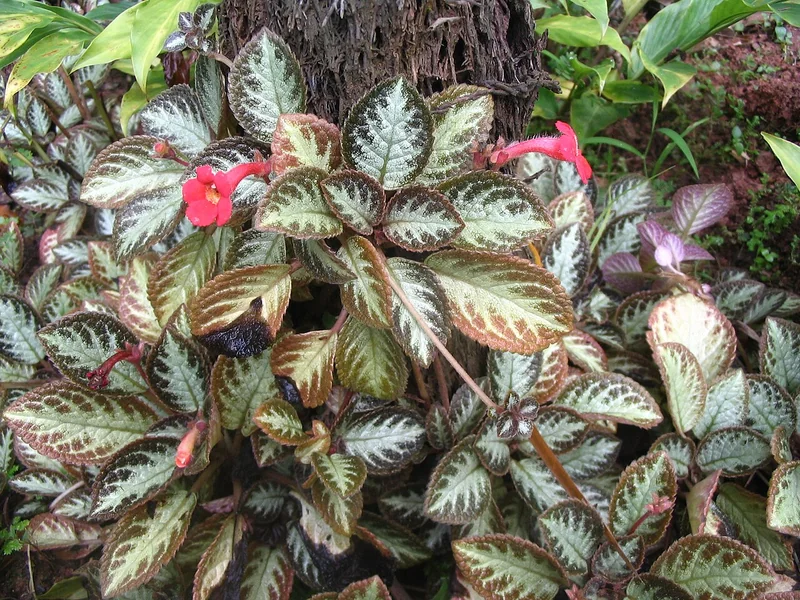
Episcia cupreata, sold as the flame violet, is a Colombian gesneriad with broad fuzzy ovate leaves marked in copper-bronze along the veins and bright red tubular flowers in the leaf axils. Mature plants creep across the substrate by stoloniferous runners.
Care facts at a glance
- Light
- Bright indirect
- Water
- Water when the top 1 to 2 cm of mix has dried.
- Humidity
- 60–80 %
- Temperature
- 18–27 °C
- Soil
- Light gesneriad mix with peat or coir and extra perlite.
- Origin
- Tropical rainforests of Colombia and Venezuela.
- Mature size
- 10 to 20 cm tall, spreading.
Overview
Episcia cupreata is a Neotropical gesneriad closely related to African violets but distinguished by its creeping habit and the copper-veined fuzzy leaves that give the trade name. The plant spreads by stoloniferous runners that root wherever they touch substrate, building dense ground-cover patches in ideal conditions.
Care Priorities
- Bright filtered light keeps the leaf veining vivid.
- Steady warm temperatures above 18 °C — Episcia is the most cold-sensitive cultivated gesneriad.
- High humidity above 60 percent prevents leaf-edge crisping.
- Water at the soil only; the fuzzy leaves spot from water droplets.
Common Problems
Pale or scorched leaves are too much direct light. Brown spots on the foliage are usually water marks from droplets that sat on the leaf surface. Sudden collapse below 15 °C is cold damage — Episcia is genuinely cold-sensitive.
Sources & further reading (2)
- encyclopedia — accessed 2026-04-29
- botanical-garden — accessed 2026-04-29
Frequently asked questions
Why are the leaf veins copper-coloured?
E. cupreata leaves carry pigmented veining that appears copper-bronze against the green leaf surface, intensifying in bright filtered light. The pattern is genetic and species-typical; cultivars selected for stronger or differently-coloured veining are the basis of most commercial trade.
Will it tolerate a cool windowsill?
No — E. cupreata is the most cold-sensitive cultivated gesneriad and suffers below 15 °C. Sustained cool conditions cause leaf collapse and stem rot. Keep the plant in a warm humid spot above 18 °C year-round.
Can I propagate from a runner?
Yes — the easiest propagation method. Pin a stoloniferous runner against moist substrate and roots form within two to three weeks. Once rooted, sever the runner from the parent plant and pot up the new plantlet.