Anthurium veitchii
Anthurium veitchii (King Anthurium) Care Guide
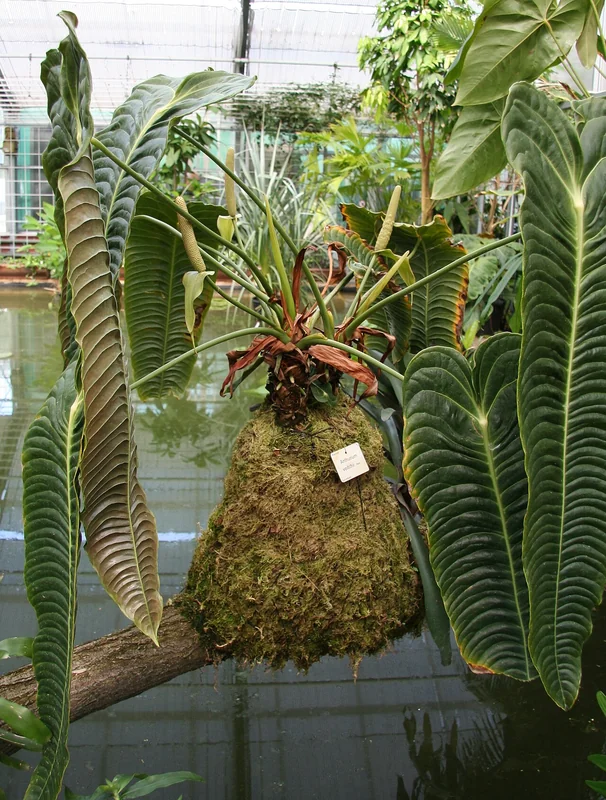 Featured photoanthurium-veitchii.jpg
Anthurium veitchii is the king of the genus, named for the long, ribbed, downward-hanging leaves that mature plants display from elevated mounts. In its native Colombian cloud forests it grows epiphytically on tree trunks, dropping leaves of one to two metres. Indoors it stays smaller but still produces dramatic, heavily corrugated foliage when given height, humidity, and a coarse mount.
Care facts at a glance
- Light
- Bright indirect
- Water
- Water thoroughly when the top 2 cm of mix or moss has dried; mounted plants dry faster than potted ones.
- Humidity
- 70–90 %
- Temperature
- 18–27 °C
- Soil
- Coarse bark and sphagnum mounted on cork or in a slatted basket; potted plants need an extra-airy aroid mix.
- Origin
- Cloud forests of the Chocó region, western Colombia.
- Mature size
- Leaves 50 to 120 cm long indoors; can be much longer mounted in greenhouses.
Overview
Anthurium veitchii grows as a pendant epiphyte in nature, anchoring on tree trunks with thick aerial roots and letting its leaves fall straight down. The corrugated, almost quilted leaf surface is one of the most distinctive in the genus.
Care Priorities
- Mount it on cork or grow in a tall, slatted basket so leaves can hang naturally.
- Keep humidity high; below 60 percent the new leaves come in flat instead of corrugated.
- Bright, filtered light — never direct midday sun on the long leaves.
- Water heavily when you do water, then let air get to the roots.
Common Problems
Flat, uncorrugated new leaves are the classic sign of low humidity at the unfurling stage. Yellowing aerial roots usually indicate overwatering or stale moss. Spider mites are the single biggest pest threat once foliage gets long — inspect undersides regularly.
Sources & further reading (2)
- encyclopedia — accessed 2026-04-28
- botanical-garden — accessed 2026-04-28
Frequently asked questions
Will indoor leaves get as long as the wild ones?
Usually no. One-metre indoor leaves are realistic with high humidity and good light, but two-metre leaves typically need a greenhouse environment.
Pot or mount?
Mounted plants display the pendant habit best, but they dry out faster and need more attention. Tall slatted baskets are a useful middle ground.
Why is the new leaf coming out twisted?
Twisted or kinked new leaves often mean the leaf got stuck unfurling because of dry air or thrip damage. Increase humidity and check the underside for tiny black insects.