Anthurium forgetii
Anthurium forgetii Care Guide
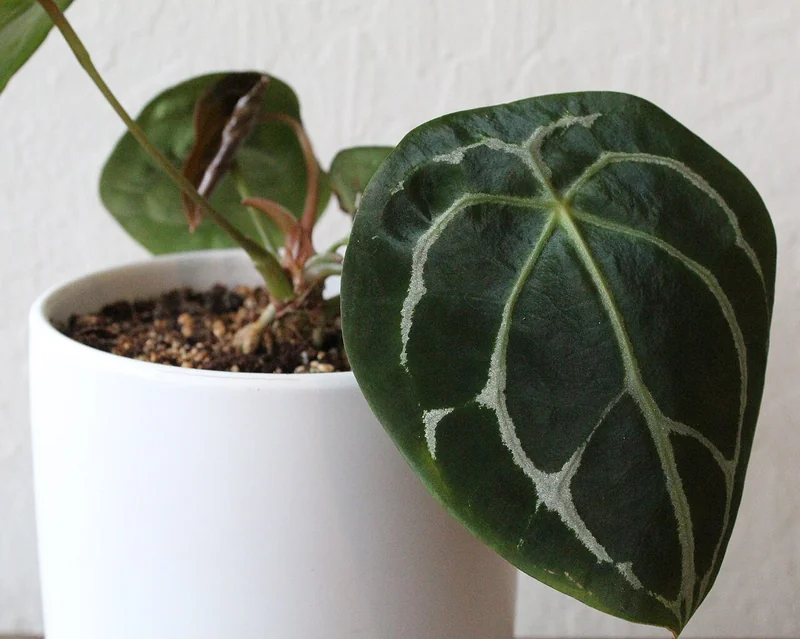 Featured photoanthurium-forgetii.jpg
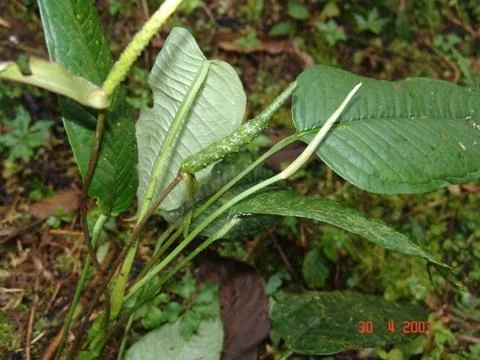
Anthurium forgetii is a compact velvet-leaf species notable for its peltate leaves: the petiole attaches in the middle of the leaf rather than at a notched top, so the foliage looks like a continuous oval shield. It comes from Colombian rainforests and stays small enough for shelf culture, with mature leaves typically 20 to 35 cm long.
Care facts at a glance
- Light
- Bright indirect
- Water
- Water when the top 2 cm of mix dries; do not let the pot go bone dry.
- Humidity
- 60–80 %
- Temperature
- 18–27 °C
- Soil
- Open aroid mix with orchid bark, perlite, and coir in roughly equal parts.
- Origin
- Lowland rainforests of Colombia.
- Mature size
- 30 to 50 cm tall, leaves 20 to 35 cm long.
Overview
Anthurium forgetii was described from Colombia in the early 1900s and named for plant collector Louis Forget. The peltate leaf form — petiole attached to the middle of the leaf — is rare in the genus and the field mark for identification.
Care Priorities
- Keep it compact in a small pot; oversized pots stay wet and rot the roots.
- Bright filtered light brings out the venation contrast.
- Hold humidity above 60 percent for crisp new leaves.
- Filter water — fluoride spotting is more obvious on its medium-sized leaves.
Common Problems
Yellow leaves with mushy bases mean the mix has stayed too wet for too long. Brown leaf tips signal dry air. New leaves coming in pale or distorted usually point to thrips, which hide in the unfurling tissue.
Sources & further reading (2)
- encyclopedia — accessed 2026-04-28
- botanical-garden — accessed 2026-04-28
Frequently asked questions
Why does the leaf shape look different from other anthuriums?
Anthurium forgetii has peltate leaves — the petiole attaches inside the leaf margin rather than at a heart-shaped notch. That is a species feature, not a deformity.
Is it good for shelves with lower light?
It tolerates moderate light better than the larger velvet species, but flowers and full leaf size still need bright filtered light.
Can I propagate it from stem cuttings?
Yes, mature plants form a slow upward stem with nodes that can be cut and rooted in damp sphagnum.