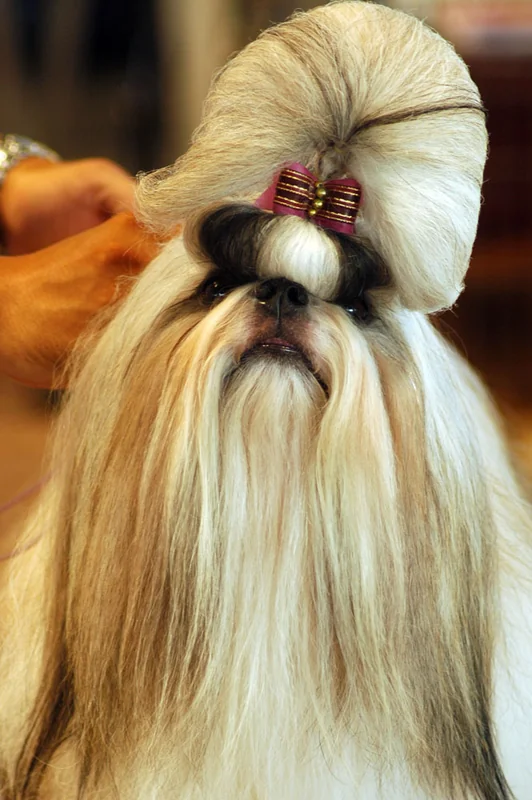
The Shih Tzu is a Tibetan-origin Chinese imperial-court chrysanthemum-faced lion-dog. The Shih Tzu (Mandarin shīzi 'lion') descends from the small Tibetan lap dogs (likely Lhasa Apso or related) presented as tribute to the Chinese imperial court of the Ming and Qing dynasties.
Quick facts
- AKC group
- Toy
- Origin country
- Tibet (refined in China)
- Origin period
- Pre-modern (Tibetan origin); modern type from 17th century
- Coat type
- Long
- Coat colors
- Any colour or combination — gold, white, black, liver, brindle, with various markings
- Average lifespan
- 10-16 years
- Recognition
- AKC 1969 · FCI 1957 · UKC 1948 · Group 9 — Companion and Toy Dogs (Section 5: Tibetan breeds)
Origin
The Shih Tzu (the name is the Mandarin shīzi, 'lion') descends from small, long-coated Tibetan lap dogs presented as tribute to the Chinese imperial court of the Ming and Qing dynasties; the Tibetan lineage is closely related to the Lhasa Apso (which the FCI still distinguishes from the Shih Tzu primarily by head shape and stop). The breed was extensively bred at the imperial palace, particularly under the Empress Dowager Cixi (reigned 1861-1908), who maintained a large breeding kennel in the Forbidden City. After the 1911 fall of the Qing dynasty and especially the 1949 Communist victory, surviving imperial dogs were exported to Europe; the modern Western breed descends from approximately seven dogs imported to England in the 1930s. The Kennel Club registered the breed in 1940 and the AKC followed in 1969.
Recognition
The American Kennel Club admitted the breed in 1969, the United Kennel Club followed in 1948, and the Federation Cynologique Internationale published the international standard (FCI No. 208) in 1957. The FCI assigns the breed to Group 9 — Companion and Toy Dogs (Section 5: Tibetan breeds).
Standard
The AKC and FCI standards describe a sturdy, lively, alert toy dog with a long flowing double coat. The defining feature is the long, dense double coat: a soft undercoat under a long, flowing, slightly wavy outer coat, which on the head grows upward as a topknot and on the muzzle as a beard and moustache (the chrysanthemum-flower face for which the breed is colloquially named). Any colour and any combination of colours is recognized; a white blaze on the forehead and a white tail tip are highly prized. The breed stands 20-28 cm at the withers and weighs 4-7.5 kg.
Sources & further reading (3)
- kennel-club-registry — accessed 2026-05-04
- encyclopedia — accessed 2026-05-04
- fci-standard — accessed 2026-05-04
Frequently asked questions
What is the Shih Tzu's AKC group?
The American Kennel Club places the Shih Tzu in the Toy Group. The Toy Group gathers small companion breeds historically kept as lap dogs and household companions, including the Pug, Pomeranian, Maltese, and Cavalier King Charles Spaniel. The breed's foundation working role was as a Tibetan-origin Chinese imperial-court chrysanthemum-faced lion-dog.
When was the Shih Tzu officially recognized?
The American Kennel Club admitted the breed in 1969; the United Kennel Club followed in 1948; the Federation Cynologique Internationale published the international standard (FCI No. 208) in 1957.
What is the average lifespan of a Shih Tzu?
Kennel-club longevity surveys place the Shih Tzu's average lifespan in the 10-16 years range. The figure here represents the spread reported by the major parent-club studies and the Kennel Club (UK) purebred-dog health surveys.