Canis lupus familiaris
Shar Pei
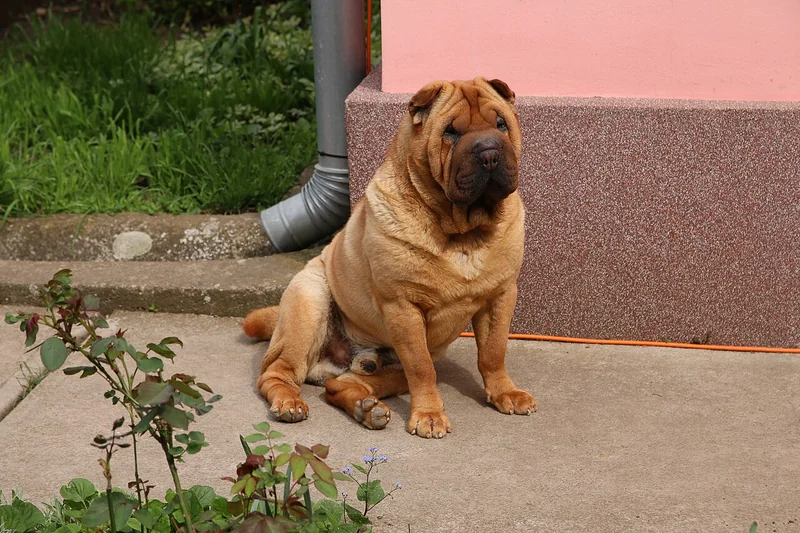 Featured photoshar-pei.jpg
The Shar Pei is a Han-dynasty southern Chinese wrinkled farm-dog rescued from 1970s extinction. The Shar Pei (Cantonese 'sand skin') is a southern Chinese breed of Han-dynasty antiquity, surviving as a working farm dog in the Guangdong town of Dah Let into the 20th century but driven to near-extinction by the Cultural Revolution.
Quick facts
- AKC group
- Non-Sporting
- Origin country
- China (Guangdong)
- Origin period
- Han dynasty (modern revival from 1973)
- Coat type
- Short
- Coat colors
- Cream, Fawn, Red, Sable, Black, Blue, Lilac (with the breed's characteristic 'flower' or 'horse' coat texture)
- Average lifespan
- 8-12 years
- Recognition
- AKC 1992 · FCI 1981 · UKC 1976 · Group 2 — Pinscher and Schnauzer-Molossoid breeds-Swiss Mountain and Cattle Dogs (Section 2.1: Molossoid breeds, Mastiff type)
Origin
The Shar Pei is a southern Chinese breed of Han-dynasty antiquity (206 BC - 220 AD), with statuettes from the Han period showing dogs of recognizably similar build. The breed survived as a working farm dog in the Guangdong town of Dah Let (Dialak) into the 20th century, where it was used for hunting, herding, and dispatching vermin. After the 1949 Communist victory, the Chinese government's drive against companion-animal ownership and the Cultural Revolution (1966-1976) drove the breed to near-extinction; only a handful of dogs survived in Hong Kong and Taiwan. In 1973, Hong Kong breeder Matgo Law made a public appeal to American fanciers via Dogs magazine; the appeal was picked up by Time and Life magazines and the breed was famously listed as the 'rarest dog in the world' in the 1978 Guinness Book of World Records. The AKC admitted the breed in 1992.
Recognition
The American Kennel Club admitted the breed in 1992, the United Kennel Club followed in 1976, and the Federation Cynologique Internationale published the international standard (FCI No. 309) in 1981. The FCI assigns the breed to Group 2 — Pinscher and Schnauzer-Molossoid breeds-Swiss Mountain and Cattle Dogs (Section 2.1: Molossoid breeds, Mastiff type).
Standard
The AKC and FCI standards describe an alert, compact, short-coupled dog of medium size with a heavily-wrinkled head and considerable folds of skin in the puppy that decrease somewhat in the adult. The defining features are the wrinkled skin, the blue-black tongue (shared only with the Chow Chow), the small sunken eyes set in heavy folds, and the harsh-textured short coat. Three coat varieties are recognized: 'horse-coat' (extremely short and harsh), 'brush-coat' (slightly longer and softer, up to 2.5 cm), and 'bear-coat' (longer than 2.5 cm — disqualified under FCI). Solid colours and sable are recognized; flowered (parti-colour) is disqualified.
Sources & further reading (3)
- kennel-club-registry — accessed 2026-05-04
- encyclopedia — accessed 2026-05-04
- fci-standard — accessed 2026-05-04
Frequently asked questions
What is the Shar Pei's AKC group?
The American Kennel Club places the Shar Pei in the Non-Sporting Group. The Non-Sporting Group is the AKC's residual category for breeds whose modern role does not fit the older Sporting / Hound / Working / Terrier / Toy / Herding rubrics; the Bulldog, Dalmatian, and Poodle sit here. The breed's foundation working role was as a Han-dynasty southern Chinese wrinkled farm-dog rescued from 1970s extinction.
When was the Shar Pei officially recognized?
The American Kennel Club admitted the breed in 1992; the United Kennel Club followed in 1976; the Federation Cynologique Internationale published the international standard (FCI No. 309) in 1981.
What is the average lifespan of a Shar Pei?
Kennel-club longevity surveys place the Shar Pei's average lifespan in the 8-12 years range. The figure here represents the spread reported by the major parent-club studies and the Kennel Club (UK) purebred-dog health surveys.