Canis lupus familiaris
Pekingese
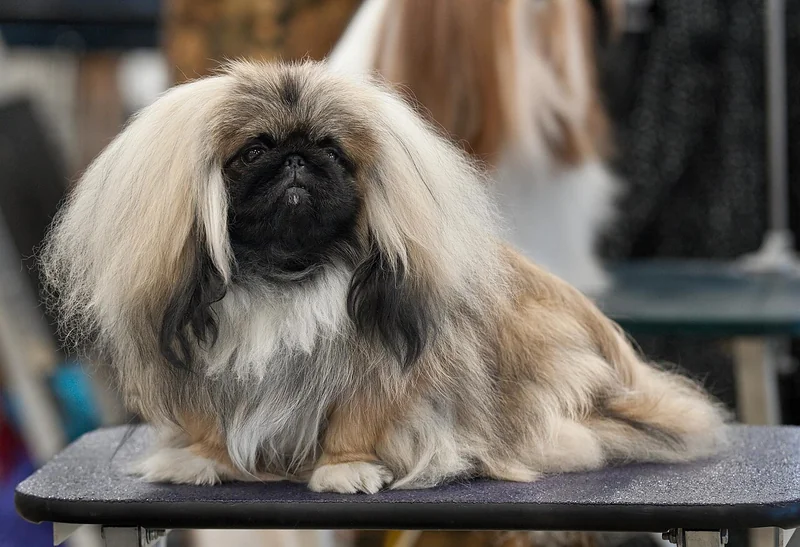 Featured photopekingese.jpg
The Pekingese is a Tang-dynasty Chinese imperial-court sacred lion-dog — looted from the 1860 Old Summer Palace. The Pekingese is one of the four classes of small flat-faced lap-dogs maintained at the Chinese imperial court (alongside the Pug, Japanese Chin, and Shih Tzu) from at least the Tang dynasty (618-907 AD).
Quick facts
- AKC group
- Toy
- Origin country
- China (Beijing / Forbidden City)
- Origin period
- Tang dynasty (modern type from 19th century)
- Coat type
- Long
- Coat colors
- Any colour or combination — gold, red, sable, cream, black, white, parti-colour, with the breed's required black mask
- Average lifespan
- 12-14 years
- Recognition
- AKC 1906 · FCI 1956 · UKC 1948 · Group 9 — Companion and Toy Dogs (Section 8: Japan Chin and Pekingese)
Origin
The Pekingese is one of the four classes of small flat-faced lap-dogs maintained at the Chinese imperial court (alongside the Pug, Japanese Chin, and Shih Tzu) from at least the Tang dynasty (618-907 AD). The breed was a sacred dog of the Chinese imperial family — the breeding programme was conducted within the Forbidden City under direct imperial supervision and Pekingese could not be owned by anyone outside the imperial family on pain of death. The breed reached the West when British and French troops looted the Old Summer Palace (Yuanmingyuan) outside Beijing in October 1860 during the Second Opium War. Five Pekingese were found alive in the rubble; one was given by Captain John Hart Dunne to Queen Victoria, who named her Looty. The breed was extensively bred in late-Victorian England and the AKC registered it in 1906.
Recognition
The American Kennel Club admitted the breed in 1906, the United Kennel Club followed in 1948, and the Federation Cynologique Internationale published the international standard (FCI No. 207) in 1956. The FCI assigns the breed to Group 9 — Companion and Toy Dogs (Section 8: Japan Chin and Pekingese).
Standard
The AKC and FCI standards describe a small, well-balanced, thickset, profusely-coated toy dog with great dignity and a quality of character that is not easily described — a leonine appearance with a bold, courageous bearing. The defining features are the broad, flat skull with a very flat, wrinkled muzzle, the heart-shaped pendant ears, and the long, profuse, straight outer coat with a thick undercoat that forms a leonine mane on the neck and shoulders. Any colour or combination is recognized; a black mask on the muzzle and around the eyes is required. The breed stands 15-23 cm and weighs 3-6.5 kg.
Sources & further reading (3)
- kennel-club-registry — accessed 2026-04-30
- encyclopedia — accessed 2026-04-30
- fci-standard — accessed 2026-04-30
Frequently asked questions
What is the Pekingese's AKC group?
The American Kennel Club places the Pekingese in the Toy Group. The Toy Group gathers small companion breeds historically kept as lap dogs and household companions, including the Pug, Pomeranian, Maltese, and Cavalier King Charles Spaniel. The breed's foundation working role was as a Tang-dynasty Chinese imperial-court sacred lion-dog — looted from the 1860 Old Summer Palace.
When was the Pekingese officially recognized?
The American Kennel Club admitted the breed in 1906; the United Kennel Club followed in 1948; the Federation Cynologique Internationale published the international standard (FCI No. 207) in 1956.
What is the average lifespan of a Pekingese?
Kennel-club longevity surveys place the Pekingese's average lifespan in the 12-14 years range. The figure here represents the spread reported by the major parent-club studies and the Kennel Club (UK) purebred-dog health surveys.