Canis lupus familiaris
Papillon
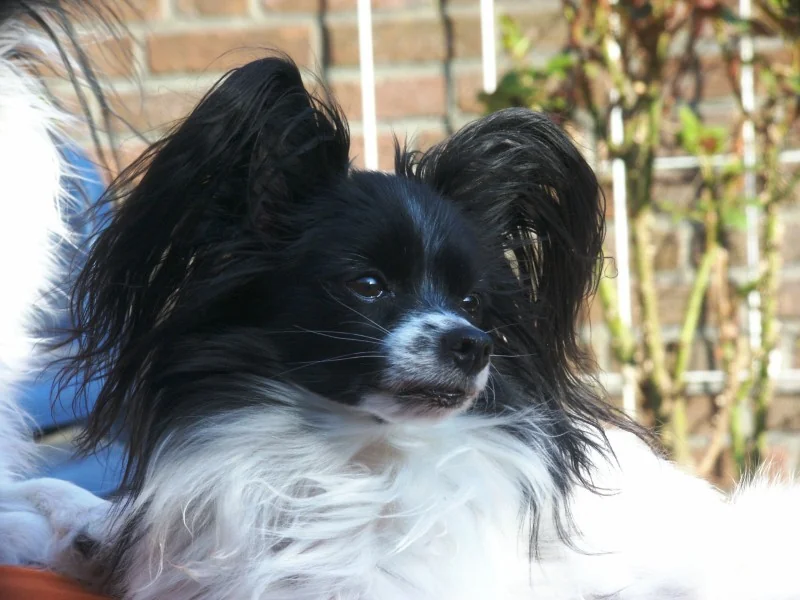 Featured photopapillon.jpg
The Papillon is a butterfly-eared French and Spanish court spaniel of the 16th-18th centuries. The Papillon (French for 'butterfly', after the breed's distinctive winged-out ears) descends from the dwarf spaniels depicted in Italian Renaissance paintings of the 13th-16th century.
Quick facts
- AKC group
- Toy
- Origin country
- France / Belgium
- Origin period
- 16th century
- Coat type
- Long
- Coat colors
- White with patches of any colour except liver — Red and White, Black and White, Sable and White, Tricolor
- Average lifespan
- 13-15 years
- Recognition
- AKC 1915 · FCI 1954 · UKC 1948 · Group 9 — Companion and Toy Dogs (Section 9: Continental Toy Spaniel and Russian Toy)
Origin
The Papillon descends from the dwarf spaniels of medieval Europe, depicted in Italian Renaissance paintings of the 13th-16th century — Tiziano, Veronese, Mignard, and Pierre Mignard's 1668 'La Maréchale d'Estrées' all show recognizable ancestors of the modern breed. The breed was a favourite of the French and Spanish royal courts; Marie Antoinette is reputed to have walked with a Papillon to the guillotine in 1793, and Madame de Pompadour kept several. Originally the breed had only the drop-eared form (now called Phalène, French for 'moth'); the prick-eared 'Papillon' (French for 'butterfly') variant — with the wing-like ear fringes for which the breed is named — emerged in the late 19th century. The two forms are recognized as a single breed by all major registries.
Recognition
The American Kennel Club admitted the breed in 1915, the United Kennel Club followed in 1948, and the Federation Cynologique Internationale published the international standard (FCI No. 77) in 1954. The FCI assigns the breed to Group 9 — Companion and Toy Dogs (Section 9: Continental Toy Spaniel and Russian Toy).
Standard
The AKC and FCI standards describe a small, friendly, elegant toy dog of fine-boned structure, light, dainty, and lively. The defining features are the large, butterfly-like ears (in the prick-eared Papillon variety, with profuse white feathering forming the 'butterfly wings') and the long, abundant, fine, silky coat. Recognized colours are white ground with patches of any colour except liver: red-and-white, black-and-white, sable-and-white, and tricolour are typical. The breed stands 20-28 cm at the withers and weighs 2-5 kg.
Sources & further reading (3)
- kennel-club-registry — accessed 2026-04-30
- encyclopedia — accessed 2026-04-30
- fci-standard — accessed 2026-04-30
Frequently asked questions
What is the Papillon's AKC group?
The American Kennel Club places the Papillon in the Toy Group. The Toy Group gathers small companion breeds historically kept as lap dogs and household companions, including the Pug, Pomeranian, Maltese, and Cavalier King Charles Spaniel. The breed's foundation working role was as a butterfly-eared French and Spanish court spaniel of the 16th-18th centuries.
When was the Papillon officially recognized?
The American Kennel Club admitted the breed in 1915; the United Kennel Club followed in 1948; the Federation Cynologique Internationale published the international standard (FCI No. 77) in 1954.
What is the average lifespan of a Papillon?
Kennel-club longevity surveys place the Papillon's average lifespan in the 13-15 years range. The figure here represents the spread reported by the major parent-club studies and the Kennel Club (UK) purebred-dog health surveys.