Canis lupus familiaris
Irish Terrier
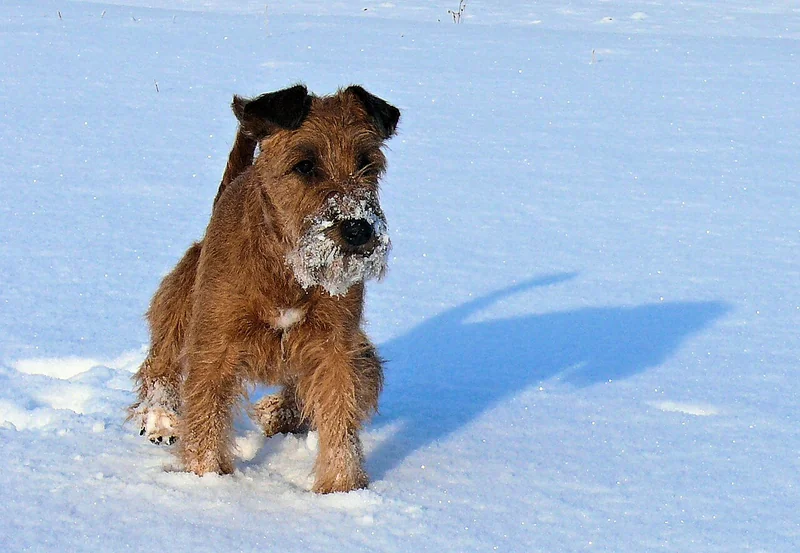 Featured photoirish-terrier.jpg
The Irish Terrier is one of the oldest terrier breeds and the only solid-red terrier recognised by major kennel clubs, its warm, wheaten-to-rich-red wire coat setting it apart from all other terriers. Known as the 'Red Devil' for its fiery spirit and the 'Daredevil' for its fearlessness, the Irish Terrier was Ireland's all-purpose farm dog — used for vermin control, hunting otter and rabbit, and guarding the farmstead. It served extensively as a military messenger and rat hunter in World War I. The AKC recognised the breed in 1885. Males stand 43–47 cm and weigh about 12 kg.
Quick facts
- AKC group
- Terrier
- Origin country
- Ireland
- Origin period
- 17th century
- Coat type
- Wirehaired
- Coat colors
- Red, Golden Red, Wheaten Red
- Average lifespan
- 13-15 years
- Recognition
- AKC 1885 · FCI 1954 · UKC 1919 · Group 3 — Terriers (Section 1: Large and medium-sized Terriers)
Origin
The Irish Terrier's roots lie in southern Ireland, particularly County Cork, where a long-legged, red-coated wire-haired terrier was well established in rural farming communities by the early 18th century. This dog served multiple roles — controlling rats and mice in outbuildings, hunting rabbits and otter, guarding farmsteads, and accompanying hunters in the field. Its solid red coat (unique among terriers) and its hot-blooded temperament made it immediately distinguishable from other terrier types. Breed exhibitions in Dublin from 1873 attracted significant attention.
Recognition
The Irish Terrier Club, founded in 1879, is one of the earliest national terrier breed clubs and drew up the first formal breed standard the same year. The AKC included the breed in its 1885 studbook, one of the first cohort of terrier recognitions. The FCI (FCI No. 139) recognised the Irish Terrier in 1954. The breed's service in World War I — where it carried messages, located wounded soldiers, and killed trench rats — generated considerable public admiration in Britain and Ireland.
Standard
The AKC and FCI standards describe an active, lithe, balanced dog of medium size with a strong, muscular body. The head is long and flat, with a well-filled foreface and a powerful jaw. The coat is dense and wiry — not soft or silky — lying close to the body; the colour must be wholly red, golden red, or red wheaten. No white markings are desirable except a small white spot on the chest. The tail is customarily docked to three-quarters of its natural length in countries where docking is legal. Males stand 43–47 cm and weigh about 12 kg; females slightly smaller.
Sources & further reading (3)
- kennel-club-registry — accessed 2026-05-07
- encyclopedia — accessed 2026-05-07
- fci-standard — accessed 2026-05-07
Frequently asked questions
What AKC group does the Irish Terrier belong to?
The AKC places the Irish Terrier in the Terrier Group. The breed is one of the oldest and largest of the terrier breeds, historically a versatile working dog used for ratting, otter hunting, rabbit coursing, and farm guarding in Ireland. The FCI classifies it in Group 3, Section 1 (Large and medium-sized Terriers) alongside the Airedale Terrier, Welsh Terrier, and Wire Fox Terrier.
What role did the Irish Terrier play in World War I?
The Irish Terrier served the British Army as a military messenger dog and trench-rat controller during World War I. Its size, speed, and intelligence made it effective as a message carrier between trenches and command posts under fire. Field reports described individual Irish Terriers completing dangerous missions that saved the lives of soldiers. The breed's performance in wartime service significantly enhanced its reputation and popularity in the years following the war.
Is the Irish Terrier the only solid-red terrier?
Yes. The Irish Terrier is the only AKC-recognised terrier breed that comes only in a solid red, golden red, or wheaten red colour. All other wire-coated terrier breeds have white in their standard — most have predominantly white bodies with coloured head markings. The Irish Terrier's entirely red coat is both a breed hallmark and a functional adaptation: in Ireland's landscape, the red dog against green grass was a distinct, recognisable companion for hunters.