Sgr · Sagittarii
Sagittarius Constellation
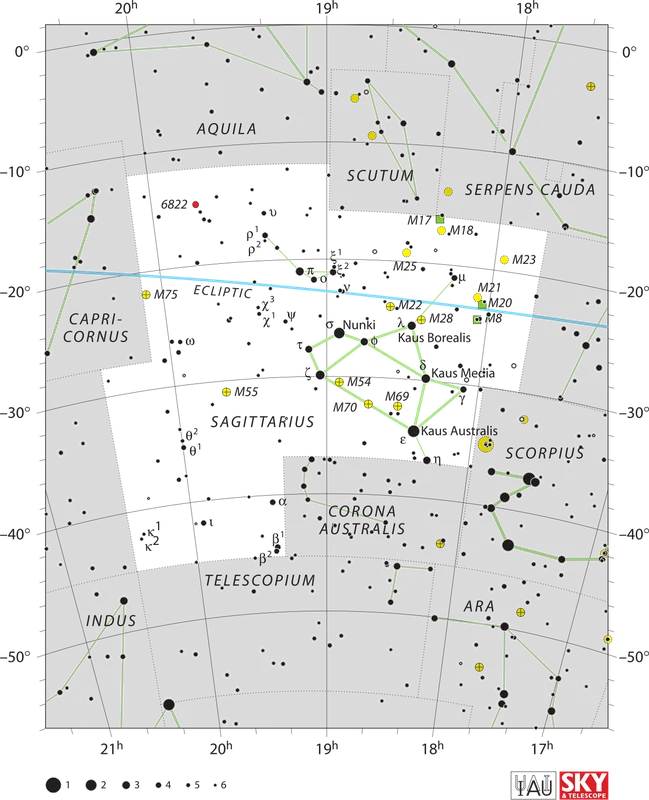 IAU constellation mapSgr
Sagittarius (Sgr) is one of the 88 constellations recognised by the International Astronomical Union. It covers 867 square degrees of the southern sky in quadrant SQ4. Its brightest star is Kaus Australis. The Latin genitive of the name is Sagittarii, used to form star names within the constellation. In Greek mythology, Sagittarius is associated with greek tradition. The IAU standardised all constellation boundaries in 1930.
Quick facts
- IAU name
- Sagittarius
- Abbreviation
- Sgr
- Latin genitive
- Sagittarii
- Hemisphere
- southern
- Area
- 867 sq deg
- Brightest star
- Kaus Australis
- Quadrant
- SQ4
- Family
- Zodiac
- Mythology origin
- Greek/Babylonian
- Discovery era
- Ptolemy's 48 (Almagest, c. 150 CE)
Mythology
Read the Sagittarius story Apple-style scroll · astronomy + classical mythology · public-domain art.
Sagittarius, the Archer, is usually depicted as a centaur drawing a bow aimed at the heart of the neighbouring Scorpion. In Babylonian astronomy the figure was the god Pabilsag, a centaur-like deity with wings and two heads; the Greeks rationalised this as either Chiron or more commonly as Crotus, the son of Pan and Eupheme who invented the art of archery and lived on Mount Helicon with the Muses, at whose request Zeus placed him in the sky. Chiron (also a centaur) is more commonly identified with Centaurus. The Milky Way is at its brightest and broadest in Sagittarius because this direction points toward the centre of the Galaxy, approximately 26,000 light-years away. Kaus Australis (Epsilon Sagittarii), the brightest star in the constellation at magnitude 1.85, is a blue giant 143 light-years from Earth. The constellation is exceptionally rich in Messier deep-sky objects: Messier 8 (the Lagoon Nebula), Messier 20 (the Trifid Nebula), Messier 17 (the Omega Nebula), and several globular clusters including M22 all lie within its boundaries — making Sagittarius arguably the most rewarding patch of sky for a small telescope.
Sources: Aratus Phaenomena 299-305; Hyginus Astronomica 2.27; Eratosthenes Catasterismi 28.
Overview
Sagittarius is one of the 88 constellations formally recognised by the International Astronomical Union (IAU). It occupies 867 square degrees of sky in the southern hemisphere sky, best visible at latitudes between +45 and -90 degrees in September. The constellation belongs to the Zodiac family of constellations. Its Latin genitive is Sagittarii, the form used when naming stars within the constellation — for example, the brightest star Kaus Australis may appear in catalogues as Alpha Sagittarii or similar. The IAU standardised the boundaries of all 88 constellations in 1930 under the direction of Eugène Delporte, using straight lines of right ascension and declination to eliminate the ambiguities of earlier variable-boundary systems.
Notable stars
The brightest star in Sagittarius is Kaus Australis. Individual stars within Sagittarius are conventionally named using Bayer designation — Greek letters followed by the Latin genitive of the constellation name (Sagittarii) — introduced by Johann Bayer in his 1603 star atlas Uranometria. Flamsteed numbers (numeric designators followed by Sagittarius) were added by John Flamsteed in his 1712 catalogue. Variable stars, double stars, and deep-sky objects within the Sagittarius boundary are catalogued by the IAU with the abbreviation Sgr.
History and mythology
The figure of Sagittarius appears in the classical astronomical tradition. Ptolemy included this constellation in the Almagest (c. 150 CE), the definitive ancient catalogue of 48 constellations, which formed the foundation for Islamic, medieval European, and Renaissance astronomy. The constellation's figure and mythology were transmitted through works such as Aratus's Phaenomena, Eratosthenes's Catasterismi, and Hyginus's Astronomica. See the Mythology section above for the full narrative.
Sources & further reading (2)
- official-iau — accessed 2026-05-06
- encyclopedia — accessed 2026-05-06
Frequently asked questions
What does the name Sagittarius mean?
Sagittarius is the Latin name used by the IAU to designate this constellation. The name comes from classical Latin and Greek astronomical tradition. In star catalogues, stars within Sagittarius are designated using the genitive form of the name (e.g. Alpha Sagittarius or similar Latin genitive forms) — a naming convention introduced by Johann Bayer in his 1603 atlas Uranometria and still in use today.
How large is Sagittarius compared to other constellations?
Sagittarius covers 867 square degrees of sky. The full sphere of the sky contains 41,253 square degrees, so Sagittarius occupies about 2.1% of the total sky. For comparison, the largest constellation is Hydra at 1303 square degrees; the smallest is Crux at 68 square degrees.
When and where is Sagittarius visible?
Sagittarius is primarily a southern hemisphere constellation. Observers at high northern latitudes cannot see it; it is best appreciated from the southern tropics or high southern latitudes. The brightest star, Kaus Australis, serves as the main visual anchor for locating the constellation. As with all constellations, the best viewing conditions are a dark sky away from artificial light pollution, with the constellation high enough above the horizon to minimise atmospheric absorption.