Com · Comae Berenices
Coma Berenices Constellation
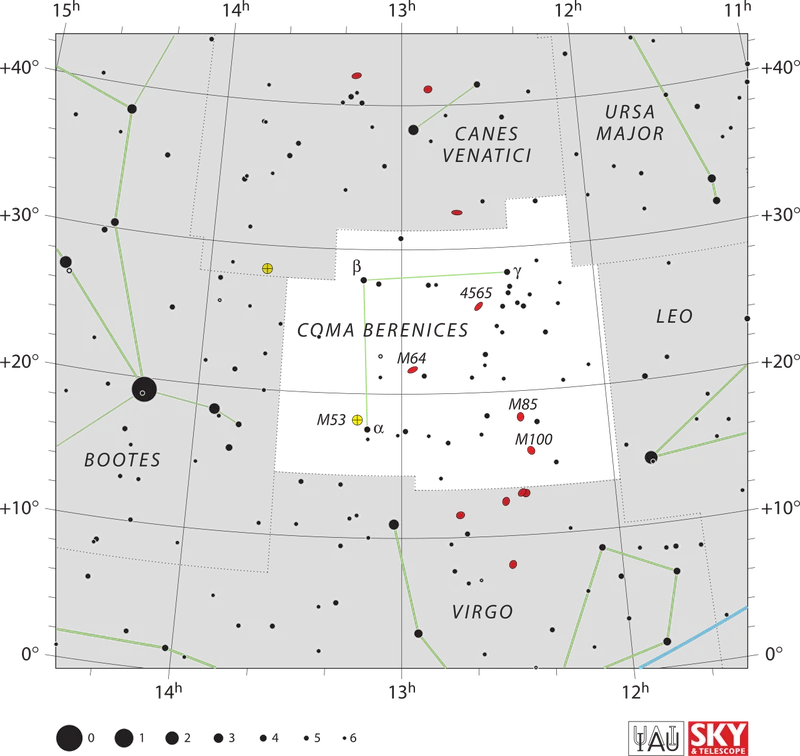 IAU constellation mapCom
Coma Berenices (Com) is one of the 88 constellations recognised by the International Astronomical Union. It covers 386 square degrees of the northern sky in quadrant NQ3. Its brightest star is Beta Comae Berenices. The Latin genitive of the name is Comae Berenices, used to form star names within the constellation. The IAU standardised all constellation boundaries in 1930.
Quick facts
- IAU name
- Coma Berenices
- Abbreviation
- Com
- Latin genitive
- Comae Berenices
- Hemisphere
- northern
- Area
- 386 sq deg
- Brightest star
- Beta Comae Berenices
- Quadrant
- NQ3
- Family
- Ursa Major
- Mythology origin
- Greek
- Discovery era
- Caspar Vopel, 1536
Mythology
Berenice's Hair commemorates a historical event of the 3rd century BCE. Queen Berenice II of Egypt vowed to dedicate her renowned hair to the gods in exchange for her husband Ptolemy III's safe return from the Third Syrian War. When Ptolemy returned victorious, the hair was placed in the temple of Aphrodite — then vanished. The court astronomer Conon of Samos declared it had been translated to the heavens as a new constellation. Hipparchus and Ptolemy treated it as an asterism; it received formal IAU constellation status in 1930. Its brightest star, Beta Comae Berenices, is a near-solar-twin lying only 30 light-years away. The region hosts the Coma Galaxy Cluster, containing over 1000 galaxies.
Sources: Catullus Carmen 66; Callimachus Lock of Berenice (fr. 110 Pfeiffer).
Overview
Coma Berenices is one of the 88 constellations formally recognised by the International Astronomical Union (IAU). It occupies 386 square degrees of sky in the northern hemisphere sky, best visible at latitudes between +90 and -60 degrees in June. The constellation belongs to the Ursa Major family of constellations. Its Latin genitive is Comae Berenices, the form used when naming stars within the constellation — for example, the brightest star Beta Comae Berenices may appear in catalogues as Alpha Comae Berenices or similar. The IAU standardised the boundaries of all 88 constellations in 1930 under the direction of Eugène Delporte, using straight lines of right ascension and declination to eliminate the ambiguities of earlier variable-boundary systems.
Notable stars
The brightest star in Coma Berenices is Beta Comae Berenices. Individual stars within Coma Berenices are conventionally named using Bayer designation — Greek letters followed by the Latin genitive of the constellation name (Comae Berenices) — introduced by Johann Bayer in his 1603 star atlas Uranometria. Flamsteed numbers (numeric designators followed by Coma Berenices) were added by John Flamsteed in his 1712 catalogue. Variable stars, double stars, and deep-sky objects within the Coma Berenices boundary are catalogued by the IAU with the abbreviation Com.
History and catalogue
Coma Berenices was introduced or documented by Caspar Vopel, 1536. The modern IAU constellation boundaries were formally established in 1930. The designation Com is the official three-letter IAU abbreviation used in star catalogues, variable star designations, and positional references. The family classification 'Ursa Major' groups this constellation with others sharing a region of sky or a common historical source in astronomical literature.
Sources & further reading (2)
- official-iau — accessed 2026-05-06
- encyclopedia — accessed 2026-05-06
Frequently asked questions
What does the name Coma Berenices mean?
Coma Berenices is the Latin name used by the IAU to designate this constellation. The name comes from classical Latin and Greek astronomical tradition. In star catalogues, stars within Coma Berenices are designated using the genitive form of the name (e.g. Alpha Coma Berenices or similar Latin genitive forms) — a naming convention introduced by Johann Bayer in his 1603 atlas Uranometria and still in use today.
How large is Coma Berenices compared to other constellations?
Coma Berenices covers 386 square degrees of sky. The full sphere of the sky contains 41,253 square degrees, so Coma Berenices occupies about 0.9% of the total sky. For comparison, the largest constellation is Hydra at 1303 square degrees; the smallest is Crux at 68 square degrees.
When and where is Coma Berenices visible?
Coma Berenices is primarily a northern hemisphere constellation, best seen from mid-northern latitudes. Southern hemisphere observers may see it low on the horizon depending on their latitude. The brightest star, Beta Comae Berenices, serves as the main visual anchor for locating the constellation. As with all constellations, the best viewing conditions are a dark sky away from artificial light pollution, with the constellation high enough above the horizon to minimise atmospheric absorption.