Felis catus
Minskin
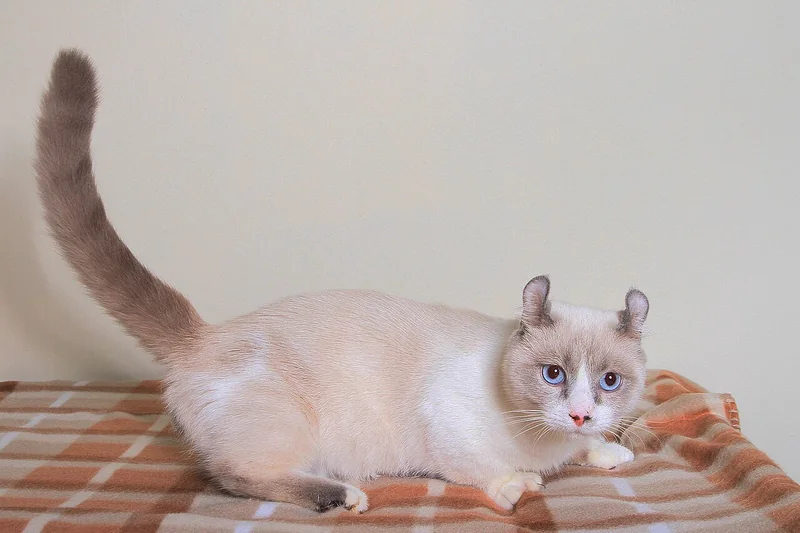
 Featured photominskin.jpg
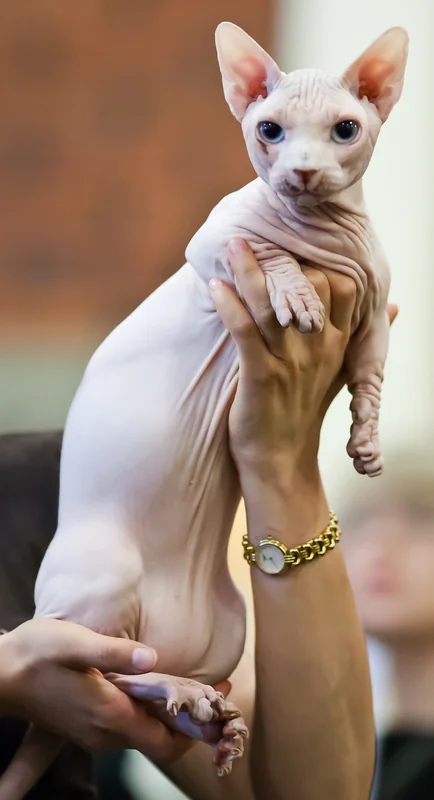
The Minskin is an experimental dwarf hybrid breed combining the Sphynx's hairless body with the Munchkin's short legs and selective fur points. The breed was developed by Paul McSorley of Boston, Massachusetts beginning in 1998. The first Minskin was born in 2000. TICA accepts the Minskin for preliminary new breed status. CFA, GCCF, and FIFe do not recognize the Minskin. The breed name combines 'mini' (small) and 'skin' (referring to the largely hairless body). The standard describes a small cat with hairless body, sparse fur on extremities, and short legs.
Quick facts
- Origin country
- United States
- Origin period
- 1998 Munchkin x Sphynx cross by Paul McSorley; TICA preliminary new breed status
- Coat type
- Hairless
- Coat colors
- All colours and patterns recognized (visible in skin pigmentation; sparse fur points on face, ears, legs, and tail)
- Size category
- Small
- Average lifespan
- 12-15 years
- Recognition
- —
Origin
Paul McSorley of Boston, Massachusetts began developing the Minskin in 1998 by crossing Munchkin cats with Sphynx, Devon Rex, and Burmese cats. The goal was a small dwarf breed combining the Sphynx's largely hairless body with the Munchkin's short legs, plus distinctive sparse fur 'points' on the face, ears, legs, and tail. The first Minskin kittens were born in 2000. The breed name combines 'mini' (small) and 'skin' (referring to the hairless body).
Recognition
TICA accepts the Minskin for preliminary new breed status. The breed has not yet advanced to championship. CFA, GCCF, and FIFe have not published Minskin standards. The breed is primarily shown through TICA-affiliated experimental classes in North America. Outcrosses to Sphynx, Devon Rex, and Munchkin are permitted to maintain genetic diversity.
Standard
The draft TICA standard describes a small, well-balanced, muscular cat with a long body relative to leg length. The defining characteristics are the Munchkin-derived short legs and the Sphynx-derived largely hairless body — combined with sparse fur 'points' on the face, ears, legs, and tail giving a Siamese-point-like outline in fur rather than colour. The skin texture is warm and chamois-like across the bald body. All colours are recognized, visible in skin pigmentation.
Sources & further reading (3)
- tica-standard — accessed 2026-04-30
- encyclopedia — accessed 2026-04-30
- encyclopedia — accessed 2026-04-30
Frequently asked questions
What three breeds were used to develop the Minskin?
The Minskin was developed by Paul McSorley from 1998 by crossing Munchkin (short-leg gene Mk), Sphynx (hairless gene hr), Devon Rex (sparse-fur gene), and Burmese (body conformation). The combined genetics produce a small dwarf cat with a hairless body, short legs, and sparse fur points on the face, ears, legs, and tail.
When was the Minskin recognized?
TICA accepts the Minskin for preliminary new breed status. CFA, GCCF, and FIFe have not published Minskin standards. The breed has not yet advanced to championship.
What does Minskin mean?
Minskin combines 'mini' (small) and 'skin' (referring to the largely hairless body). The name was chosen by breed founder Paul McSorley to capture both the breed's small dwarf size from the Munchkin parent and the bare-skinned body from the Sphynx parent.