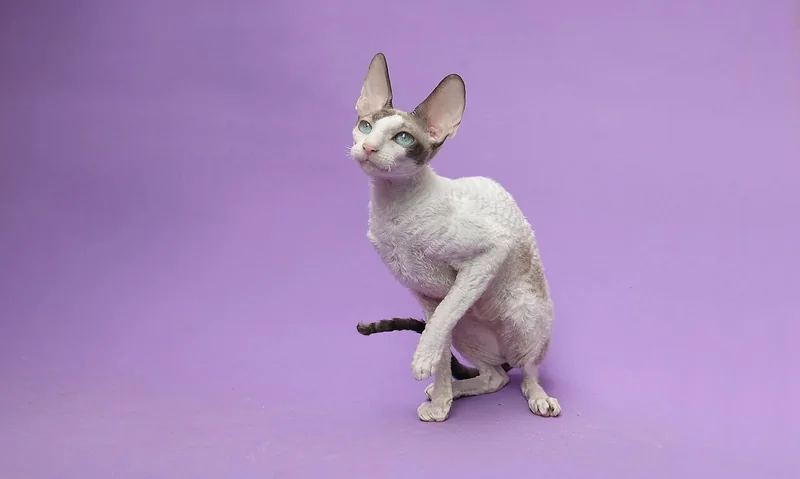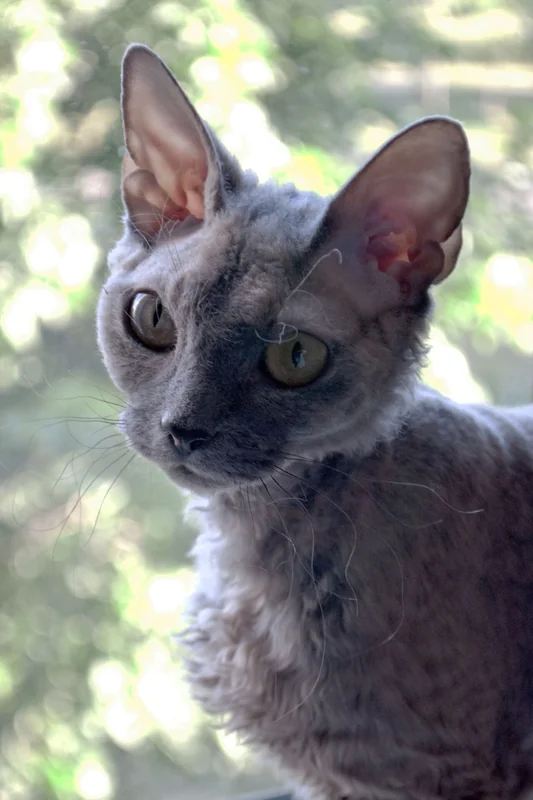
The Devon Rex is a curly-coated breed originating from a natural mutation in Buckfastleigh, Devon, in 1960. The foundation male, Kirlee, was bred by Beryl Cox from a feral curly-coated tom and a domestic queen. The Governing Council of the Cat Fancy recognized the breed in 1967; CFA admitted it in 1979; TICA at its 1979 founding; and FIFe in 1998. The standard describes a small, elfin cat with large ears, prominent cheekbones, and a short wavy coat.
Quick facts
- Origin country
- United Kingdom (Buckfastleigh, Devon)
- Origin period
- 1960 natural curly-coat mutation (Kirlee); GCCF recognition 1967
- Coat type
- Curly
- Coat colors
- All colours and patterns recognized
- Size category
- Small
- Average lifespan
- 9-15 years
- Recognition
- CFA 1979 · TICA 1979 · GCCF 1967 · FIFe 1998
Origin
A curly-coated male kitten named Kirlee was born in Buckfastleigh, Devon in 1960, descended from a wild curly-coated tom spotted near local tin mines. Beryl Cox bred this tom to a straight-coated queen from the same feral colony to produce Kirlee. When Kirlee was bred with Cornish Rex cats, all offspring were straight-coated, demonstrating that the Devon mutation (gene re) is genetically distinct from the Cornish Rex mutation (gene r). This allelic test established the Devon Rex as a separate breed.
Recognition
The Governing Council of the Cat Fancy recognized the Devon Rex as a distinct breed in 1967, separate from the Cornish Rex. The Cat Fanciers' Association admitted the Devon Rex to championship in 1979. The International Cat Association recognized it at its 1979 founding. The Fédération Internationale Féline published its standard in 1998. All four major international registries now maintain current Devon Rex standards.
Standard
The CFA standard describes a small to medium-sized cat with a firm, muscular body, a broad chest, and slender neck. The head is a modified wedge with a flat skull, prominent cheekbones, a short broad nose, and a strong chin. The ears are very large and set low on the head, framing the face. The coat is short, soft, and curly or wavy across the entire body; loose, open, very soft curls are described as ideal. All colours and patterns are recognized. The facial expression is often described as elfin or pixie-like.
Sources & further reading (3)
- registry-breed-profile — accessed 2026-04-30
- encyclopedia — accessed 2026-04-30
- gccf-registry — accessed 2026-04-30
Frequently asked questions
Is the Devon Rex the same as the Cornish Rex?
No. The Devon Rex (gene re) and the Cornish Rex (gene r) carry different recessive mutations that are not allelic — crossing the two breeds produces straight-coated offspring, not curly. The Devon Rex mutation was confirmed distinct in the 1960s through test crosses. The two breeds also differ in conformation: the Devon Rex has a broader, more pixie-like head with very large low-set ears, whereas the Cornish Rex has a longer, narrower head with high-set ears.
When was the Devon Rex recognized?
The Governing Council of the Cat Fancy recognized the Devon Rex in 1967 as a breed distinct from the Cornish Rex. CFA admitted it to championship in 1979. TICA recognized it at its 1979 founding. FIFe published its standard in 1998.
What makes the Devon Rex coat unique?
The Devon Rex coat is caused by the recessive re gene, which produces short, soft, wavy or curly guard hairs, awn hairs, and down hairs. The CFA standard describes loose, open, very soft curls as ideal. The coat is considerably shorter and softer than the Cornish Rex's tightly marcelled waves and lacks the full complement of guard-hair structure found in straight-coated breeds.