Felis catus
Cornish Rex
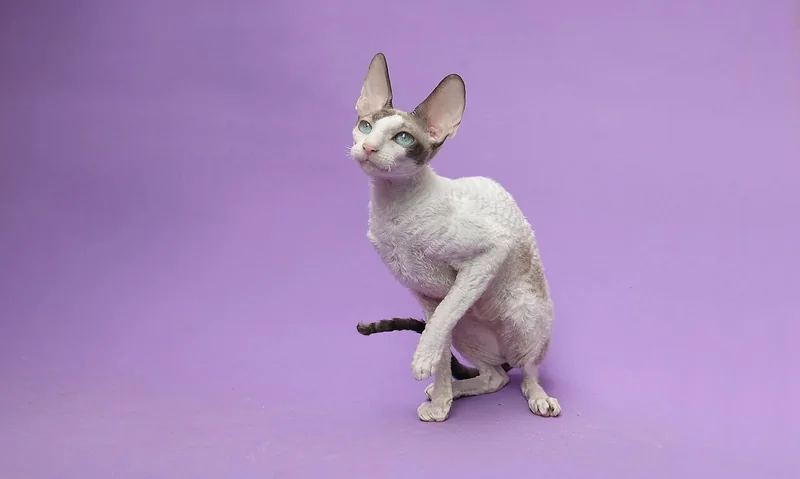 Featured photocornish-rex.jpg
The Cornish Rex is a curly-coated breed originating from a natural mutation on Bodmin Moor, Cornwall in 1950. The foundation male, Kallibunker, was born to a farm tortoiseshell queen and bred by Nina Ennismore. CFA recognized the Cornish Rex in 1964; GCCF in 1967; FIFe in 1983; and TICA at its 1979 founding. The standard describes a slender, long-bodied cat with a distinctive tightly-waved coat, an egg-shaped head, and high cheekbones.
Quick facts
- Origin country
- United Kingdom (Bodmin Moor, Cornwall)
- Origin period
- 1950 natural wavy-coat mutation (Kallibunker); CFA recognition 1964
- Coat type
- Curly
- Coat colors
- All colours and patterns recognized
- Size category
- Small
- Average lifespan
- 11-15 years
- Recognition
- CFA 1964 · TICA 1979 · GCCF 1967 · FIFe 1983
Origin
A naturally wavy-coated male kitten named Kallibunker was born in 1950 on a farm on Bodmin Moor, Cornwall, owned by Nina Ennismore. Ennismore consulted geneticist A.C. Jude, who identified the coat as a recessive natural mutation analogous to the Astrex rabbit's wavy coat. Kallibunker was bred back to his dam to confirm the mutation and produce more curly-coated offspring. British lines were nearly lost in the 1950s and were rebuilt through Siamese, Burmese, and British Shorthair outcrosses; American lines were independently developed after the first imports arrived in the United States in 1957.
Recognition
The Cat Fanciers' Association recognized the Cornish Rex in 1964. The Governing Council of the Cat Fancy recognized it in 1967. The International Cat Association recognized the breed at its 1979 founding. The Fédération Internationale Féline published its standard in 1983. All four major international registries maintain current Cornish Rex standards.
Standard
The CFA standard describes a medium-sized, slender, hard-muscled cat with a long body, arched back, deep flank, and long slender legs. The head is an egg-shape in profile, narrow but with a strongly arched skull, high cheekbones, and a Roman nose. The ears are very large, set high on the head. The coat is short, dense, and tightly marcelled in close-lying waves over the entire body; the CFA standard specifies the wave pattern as an essential breed characteristic and distinguishes it from the loose-curled Devon Rex coat.
Sources & further reading (3)
- registry-breed-profile — accessed 2026-04-30
- encyclopedia — accessed 2026-04-30
- gccf-registry — accessed 2026-04-30
Frequently asked questions
When was the Cornish Rex first recognized?
The Cat Fanciers' Association recognized the Cornish Rex in 1964 after American breeders developed lines from 1957 imports. The Governing Council of the Cat Fancy recognized it in 1967. TICA recognized the breed at its 1979 founding. FIFe published its standard in 1983.
How does the Cornish Rex coat differ from the Devon Rex?
The Cornish Rex (gene r) has a tightly marcelled, close-lying wave pattern over the entire body. The Devon Rex (gene re) has loose, open, soft curls and is caused by a different non-allelic mutation. Crossing the two breeds produces straight-coated offspring, confirming the genetic distinction. The Cornish Rex conformation is also more slender and long-bodied, with a narrower Roman-nosed head.
What is the Cornish Rex's coat made of?
The Cornish Rex coat consists of down hairs and awn hairs in a wavy or marcelled pattern; the guard hairs are reduced or absent. The result is a very soft, short, and dense coat without the stiff, flat guard hairs found in most other breeds. The mutation (gene r) affects the ratio and structure of the three hair types, producing the characteristic tightly waved texture.