Begonia pavonina
Begonia pavonina (Peacock Begonia) Care Guide
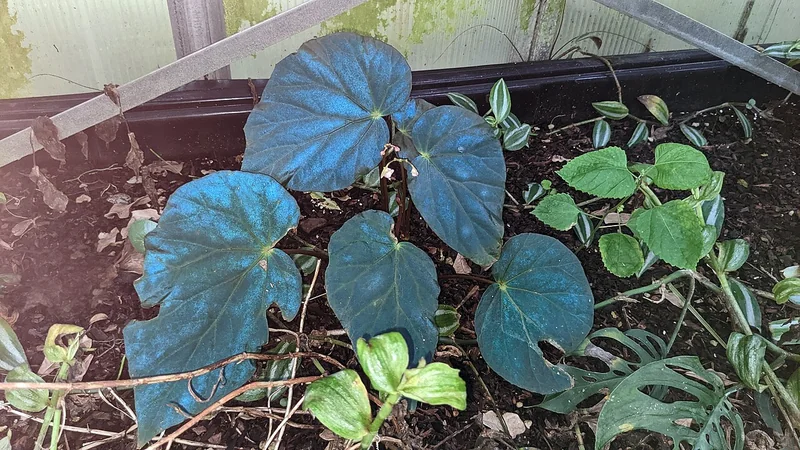 Featured photobegonia-pavonina.jpg
Begonia pavonina, sold as Peacock Begonia, is a member of *Begonia*, the second-largest flowering plant genus with about 2,000 species across the tropics. A Malaysian rainforest Begonia with broad ovate leaves that show an iridescent peacock-blue sheen in low light, the colour produced by interference patterns in the leaf surface microstructure rather than by pigment. Like most cultivated Begonia it tolerates lower light than flowering plants, prefers steady humidity, and propagates readily from leaf or stem cuttings.
Care facts at a glance
- Light
- Bright indirect
- Water
- Water when the top 2 cm of mix has dried.
- Humidity
- 50–70 %
- Temperature
- 16–24 °C
- Soil
- Light, free-draining peat-rich mix with extra perlite for aeration.
- Origin
- Tropical and subtropical forests across the Americas, Africa, and Asia, with a centre of diversity in Brazil.
- Mature size
- 20 to 60 cm tall and wide depending on species.
Overview
Begonia pavonina sits in Begonia, a hyperdiverse pantropical genus where new species are still being described almost yearly. A Malaysian rainforest Begonia with broad ovate leaves that show an iridescent peacock-blue sheen in low light, the colour produced by interference patterns in the leaf surface microstructure rather than by pigment. Begonia leaves are typically asymmetric — one half larger than the other — a trait that runs across the genus and lets botanists recognise a Begonia at a glance even on unfamiliar species.
Care Priorities
- Bright filtered light, never direct midday sun.
- Steady humidity above 50 percent prevents leaf-edge crisping.
- Water at the soil only; the leaves spot from droplets.
- Avoid drafts and sudden temperature shifts.
Common Problems
Powdery mildew on leaves indicates poor air circulation combined with high humidity — improve airflow around the plant. Brown leaf edges signal dry indoor air. Sudden leaf drop after a move is normal stress; new growth follows once conditions stabilise.
Sources & further reading (2)
- encyclopedia — accessed 2026-04-29
- botanical-garden — accessed 2026-04-29
Frequently asked questions
Why are the leaves blue?
B. pavonina leaves contain stacked photosynthetic structures that act as a thin-film interference system — the same physics that makes peacock feathers and butterfly wings blue. The structural blue intensifies in deep shade where pigment-based colour would be too inefficient, an unusual evolutionary adaptation to dim forest understorey.
Why are Begonia leaves asymmetric?
The asymmetric leaf base is a defining trait of *Begonia* — one side of each leaf is larger than the other, with the midrib offset toward the smaller side. The morphology runs across all 2,000 species and helps botanists place an unfamiliar plant in the genus on sight.
Can I propagate from a single leaf?
Yes — many Begonia root readily from a single leaf. Cut the leaf into wedges following the major veins, lay each wedge cut-edge-down on moist propagation mix, and cover loosely. Plantlets typically emerge from the cut veins within a few weeks.