Canis lupus familiaris
Norwegian Elkhound
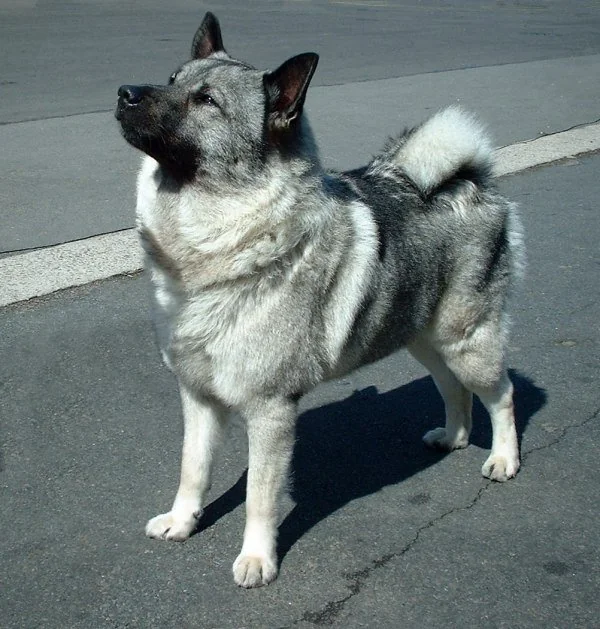 Featured photonorwegian-elkhound.jpg
The Norwegian Elkhound is a 3,000-year-old Norwegian moose-baying Nordic Spitz. The Norwegian Elkhound is one of the oldest documented Nordic Spitz breeds, with skeletons closely matching the modern breed found at Viste Cave in Norway dating to roughly 5,000 BCE.
Quick facts
- AKC group
- Hound
- Origin country
- Norway
- Origin period
- Antiquity (Viking era and earlier)
- Coat type
- Double
- Coat colors
- Grey (with darker grey saddle and lighter grey markings on chest, mask, and legs)
- Average lifespan
- 12-15 years
- Recognition
- AKC 1913 · FCI 1955 · UKC 1948 · Group 5 — Spitz and Primitive Types (Section 2: Nordic Hunting Dogs)
Origin
The Norwegian Elkhound is one of the oldest documented Nordic Spitz breeds, with skeletons closely matching the modern breed found at Viste Cave in Norway dating to roughly 5,000 BCE and at Viking-era burial sites across Scandinavia. The breed has been used by Norwegian hunters for at least 3,000 years to track and bay moose (the European 'elk', Alces alces — note that European 'elk' refers to the moose, not the North American elk/wapiti) until the hunter arrives — the bay-and-hold style for which the breed is named. The Norsk Kennel Klub was founded in 1898 and the breed was the first to be registered. The AKC admitted the Norwegian Elkhound in 1913.
Recognition
The American Kennel Club admitted the breed in 1913, the United Kennel Club followed in 1948, and the Federation Cynologique Internationale published the international standard (FCI No. 242) in 1955. The FCI assigns the breed to Group 5 — Spitz and Primitive Types (Section 2: Nordic Hunting Dogs).
Standard
The AKC and FCI standards describe a hardy grey hunting dog of medium size and substance, square in profile, close-coupled and balanced. The defining feature is the thick, harsh, weather-resistant double coat in grey only — a silver-grey ground colour with a darker grey saddle, lighter grey on the underside and tail, and a black mask on the muzzle and ear tips. The high-set, tightly-curled tail carried over the back is a breed-defining hallmark. Males stand 52 cm at the withers, females 48 cm.
Sources & further reading (3)
- kennel-club-registry — accessed 2026-04-30
- encyclopedia — accessed 2026-04-30
- fci-standard — accessed 2026-04-30
Frequently asked questions
What is the Norwegian Elkhound's AKC group?
The American Kennel Club places the Norwegian Elkhound in the Hound Group. The Hound Group gathers breeds developed for the hunt, broadly split into scent hounds (Bloodhound, Beagle, Coonhounds) and sight hounds (Greyhound, Whippet, Borzoi). The breed's foundation working role was as a 3,000-year-old Norwegian moose-baying Nordic Spitz.
When was the Norwegian Elkhound officially recognized?
The American Kennel Club admitted the breed in 1913; the United Kennel Club followed in 1948; the Federation Cynologique Internationale published the international standard (FCI No. 242) in 1955.
What is the average lifespan of a Norwegian Elkhound?
Kennel-club longevity surveys place the Norwegian Elkhound's average lifespan in the 12-15 years range. The figure here represents the spread reported by the major parent-club studies and the Kennel Club (UK) purebred-dog health surveys.